Why in News: On 20 October 2026 India added three sites to its UNESCO World Heritage Tentative List — the Karst–Mud Volcano Complex of Baratang and the Andaman Subduction Volcanoes (Barren and Narcondam islands) in the Andaman and Nicobar Islands, and the Sirpur Cultural and Archaeological Landscape in Chhattisgarh — taking the list to 81 sites. Earlier in the month heritage groups opposed a proposed opencast coal mine near the 13th-century Ramappa (Rudreshwara) Temple, a World Heritage Site in Telangana, warning of blasting damage to its unique foundations and lake.
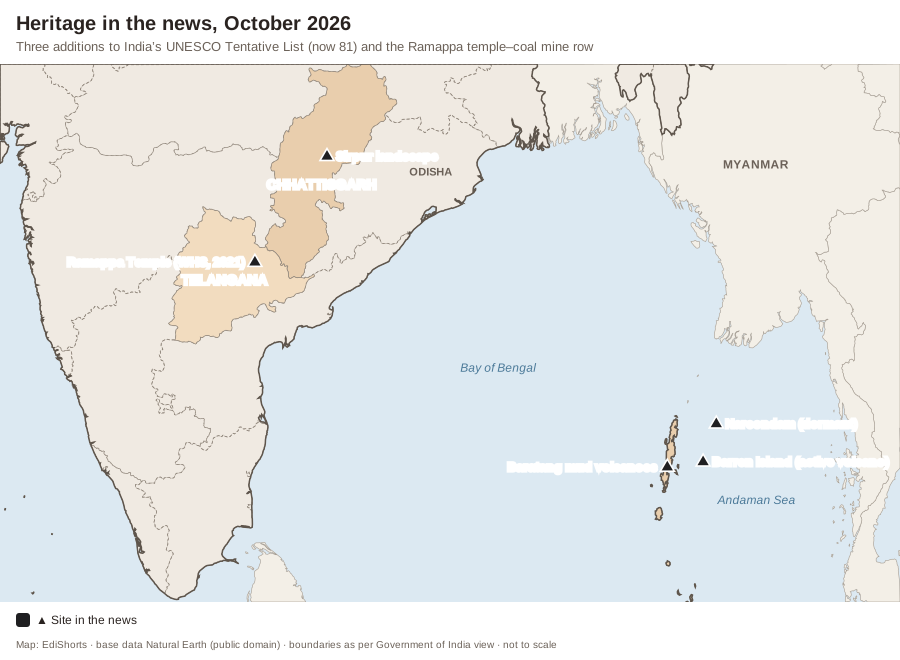
The New Tentative-List Sites
- Baratang: India’s only known mud volcanoes, plus limestone caves, within the Jarawa Tribal Reserve; the Geological Survey of India has recognised its geological importance.
- Andaman Subduction Volcanoes: Barren Island — India’s (and South Asia’s) only confirmed active volcano — and dormant Narcondam, formed where the Indian plate subducts beneath the Burma micro-plate; Narcondam is home to the endemic Narcondam hornbill.
- Sirpur: on the Mahanadi, a capital of the Panduvamshi/Somavamshi rulers (6th–8th centuries); the brick Lakshmana Temple, Buddhist viharas, Jain shrines and a large market complex; the Chinese pilgrim Xuanzang described the region.
Ramappa Temple and the Mine
- Built around 1213 by Recharla Rudra, a general of the Kakatiya king Ganapati Deva, at Palampet (Mulugu district); named after its sculptor Ramappa.
- Engineering marvels: a “sandbox” foundation (sand fill that absorbs earthquake shocks), light “floating” bricks in the roof and finely carved basalt brackets with dancers (madanikas).
- Inscribed as a World Heritage Site in 2021 (“Kakatiya Rudreshwara (Ramappa) Temple”).
- Concern: blasting and groundwater changes from an opencast mine could crack foundations and harm the adjoining Ramappa lake (a Kakatiya tank). Heritage bylaws under the AMASR Act prohibit construction within 100 m and regulate 200 m around protected monuments; World Heritage status adds international scrutiny.
Static Background — World Heritage
- Convention concerning the Protection of the World Cultural and Natural Heritage (UNESCO, 1972); India ratified it in 1977.
- A site must be on a country’s Tentative List before it can be nominated; the World Heritage Committee decides inscription.
- India has over 40 World Heritage Sites (cultural, natural and mixed — Khangchendzonga is India’s only mixed site); the Maratha Military Landscapes were inscribed in 2025.
- Ancient Monuments and Archaeological Sites and Remains (AMASR) Act, 1958: prohibited area of 100 m and regulated area of 200 m around protected monuments; the Archaeological Survey of India (1861, Alexander Cunningham) is the custodian.
| Site | State / UT | Type |
|---|---|---|
| Baratang karst–mud volcano complex | Andaman & Nicobar | Natural |
| Andaman subduction volcanoes | Andaman & Nicobar | Natural |
| Sirpur landscape | Chhattisgarh | Cultural |
| Ramappa Temple (inscribed 2021) | Telangana | Cultural |
Exam Angle — Prelims & Mains
- UPSC PYQ Link: Prelims has asked about Barren Island and India’s volcanoes, and about Kakatiya architecture.
- Practice Mains Question (GS Paper 1, 15 marks, 250 words): Development projects near heritage sites test India’s commitment to conservation. Discuss with reference to the Ramappa Temple and the role of heritage laws.
- Prelims Angle: site facts, AMASR distances, Kakatiya features.
- Practice Prelims MCQ 1: Consider the following statements:1. Barren Island is the only confirmed active volcano in India.2. Baratang is known for mud volcanoes.3. Narcondam island is an active volcano that erupted in 2017.Which of the statements given above are correct?(A) 1 and 2 only(B) 2 and 3 only(C) 1 and 3 only(D) 1, 2 and 3
Show answer
Answer: (A) 1 and 2 only — Statement 1 is CORRECT and Statement 2 is CORRECT. Statement 3 is INCORRECT — Narcondam is considered dormant; Barren Island is the active one. - Practice Prelims MCQ 2: The Ramappa Temple, a World Heritage Site, was built during the rule of which dynasty?(A) Chalukyas of Badami(B) Kakatiyas(C) Hoysalas(D) Vijayanagara
Show answer
Answer: (B) — It was built in 1213 under the Kakatiya king Ganapati Deva.
- Practice Prelims MCQ 1: Consider the following statements: