Why in News: Operation Trident, a multi-agency crackdown on an international drug syndicate along the India–Myanmar–Bangladesh corridor, made headlines in late October 2026. The Union Home Minister has set 31 December 2029 as the deadline to eradicate drug networks nationwide, under a Vision Document on Drug Control (2026–2029) involving over 40 ministries, agencies, States and the pharmaceutical sector. An editorial (“Small fish”, 28 October) argued that arrests and seizures have surged — NDPS cases rose about 53% and arrests over 50% in 2025 — but kingpins abroad and the money trail are rarely touched.
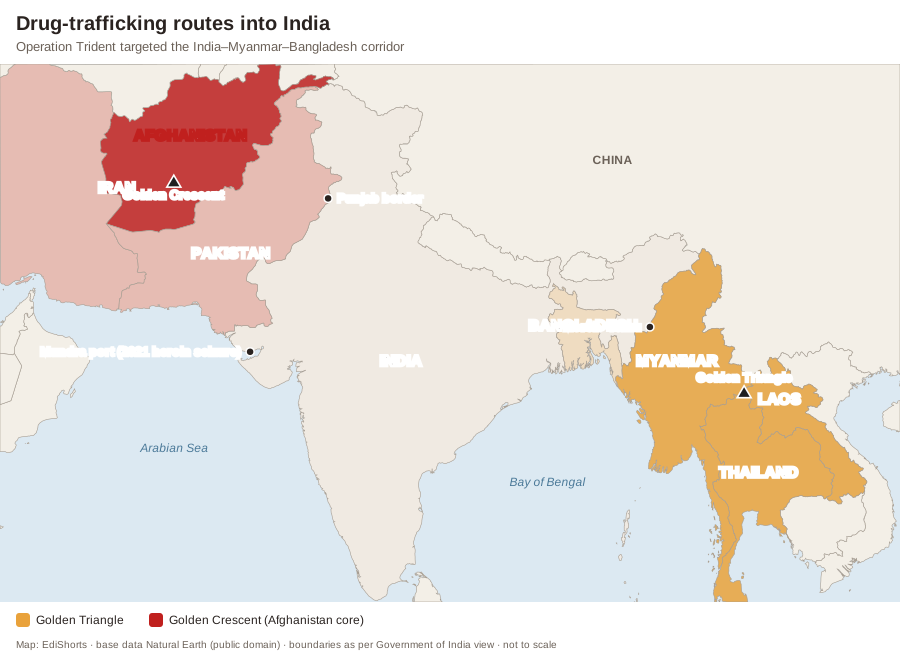
The Threat
- East: methamphetamine tablets and heroin from Myanmar’s Shan state (Golden Triangle) enter through Manipur and Mizoram; the open India–Myanmar border has been fenced in parts and the Free Movement Regime curtailed.
- West: heroin from Afghanistan and Pakistan (Golden Crescent) through Punjab — increasingly delivered by drones — and by sea through Gujarat (the 2021 Mundra port seizure of about 3,000 kg of heroin).
- New threats: synthetic drugs, darknet sales paid in cryptocurrency, and diversion of pharmaceutical opioids (tramadol, codeine syrups).
- Links to terror financing and insurgency (narco-terrorism).
Why “Small Fish” Is the Problem
- Most arrests are of carriers and users; foreign suppliers and financiers stay out of reach.
- Low conviction rates and long trials; users treated as criminals rather than patients.
- Punjab’s continuing public-health crisis shows seizures alone do not reduce availability.
Way Forward
- Follow the money: financial investigation, asset forfeiture under the NDPS Act, cooperation with the FIU and ED.
- Regional cooperation with Myanmar, Bangladesh and Gulf transit states; intelligence sharing through BIMSTEC and UNODC.
- Treat addiction as health: de-addiction and rehabilitation, the Nasha Mukt Bharat Abhiyaan (2020), the MANAS helpline (1933); protect whistle-blowers and activists.
Static Background — Drug Control Law
- Narcotic Drugs and Psychotropic Substances (NDPS) Act, 1985: offences graded by small, intermediate and commercial quantity; Section 27A — financing illicit traffic; Chapter VA — forfeiture of property.
- Prevention of Illicit Traffic in NDPS Act, 1988 — preventive detention.
- Narcotics Control Bureau (1986) — nodal agency under the Home Ministry.
- Article 47 (DPSP): the State shall endeavour to prohibit consumption of intoxicating drinks and drugs injurious to health, except for medicinal purposes.
- International conventions: Single Convention on Narcotic Drugs (1961), Convention on Psychotropic Substances (1971), UN Convention against Illicit Traffic (1988); UNODC publishes the World Drug Report. 26 June — International Day against Drug Abuse.
| Region | Countries | Main drugs |
|---|---|---|
| Golden Crescent | Afghanistan, Pakistan, Iran | Heroin, opium |
| Golden Triangle | Myanmar, Laos, Thailand | Methamphetamine, heroin |
Exam Angle — Prelims & Mains
- UPSC PYQ Link: Mains GS-3 has asked about drug trafficking along India’s borders and its links with terrorism; Prelims about the Golden Crescent/Triangle countries.
- Practice Mains Question (GS Paper 3, 15 marks, 250 words): Rising drug seizures do not mean falling drug use. Critically examine India’s strategy against narcotics trafficking and suggest improvements.
- Prelims Angle: NDPS provisions, NCB and the regions.
- Practice Prelims MCQ 1: Consider the following statements:1. The Narcotics Control Bureau functions under the Ministry of Home Affairs.2. Article 47 of the Constitution directs the State to prohibit drugs injurious to health except for medicinal purposes.3. The Golden Triangle comprises Afghanistan, Pakistan and Iran.Which of the statements given above are correct?(A) 1 and 2 only(B) 2 and 3 only(C) 1 and 3 only(D) 1, 2 and 3
Show answer
Answer: (A) 1 and 2 only — Statement 1 is CORRECT and Statement 2 is CORRECT. Statement 3 is INCORRECT — that is the Golden Crescent; the Golden Triangle is Myanmar, Laos and Thailand. - Practice Prelims MCQ 2: The 1988 UN Convention against Illicit Traffic in Narcotic Drugs and Psychotropic Substances was significant mainly because it:(A) legalised medical cannabis(B) introduced measures against money laundering and precursor chemicals(C) created the World Health Organization(D) banned tobacco advertising
Show answer
Answer: (B) — It targeted trafficking networks, including control of precursors and confiscation of proceeds.
- Practice Prelims MCQ 1: Consider the following statements: