Why in News: President Droupadi Murmu gave assent on 25 October 2026 to the Frontier Nagaland Territorial Authority (FNTA) Bill, 2026, which the Nagaland Legislative Assembly had passed unanimously on 3 September. It creates a self-governing territorial authority for six eastern districts — Tuensang, Mon, Longleng, Kiphire, Noklak and Shamator — following the Memorandum of Agreement signed on 5 February 2026 by the Centre, the Nagaland government and the Eastern Nagaland Peoples’ Organisation (ENPO). The Act will commence on a date notified by the State government.
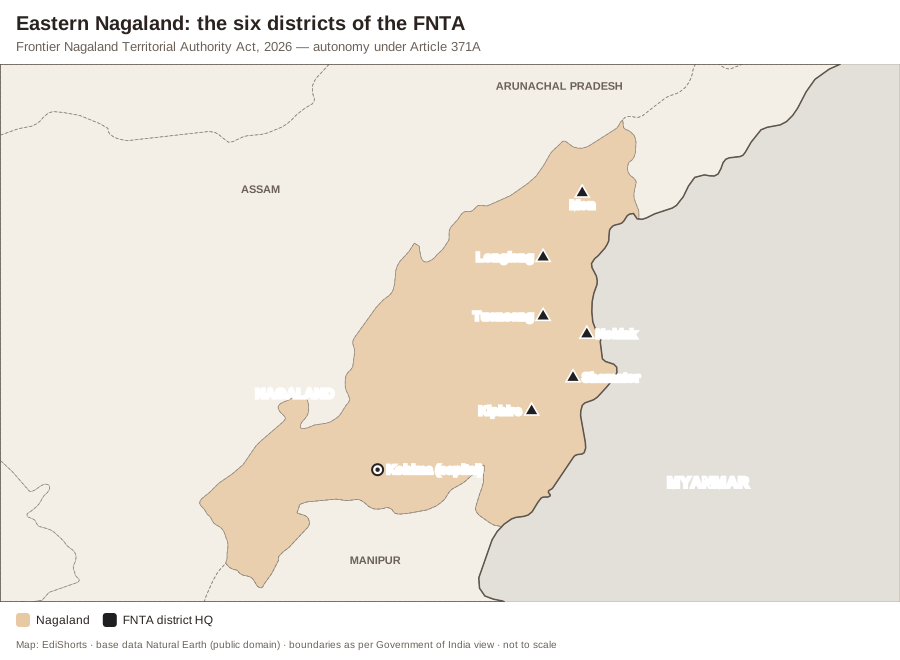
Key Features of the Act
- A territorial authority with a 62-member governing body, of whom 40 are directly elected; one-third of seats reserved for women.
- Legislative, executive, administrative and financial powers over about 46 subjects, with a share of the State’s development funds.
- It operates within Article 371A — Naga customary law, land ownership and religious-social practices remain protected.
- Commencement by State notification; an interim council will precede elections to the full authority.
Background — Why Eastern Nagaland Wanted Autonomy
- The six districts lag the rest of the State in roads, health, education and employment; several are among India’s aspirational districts.
- Since 2010 the ENPO, representing tribes such as the Konyak, Chang, Sangtam, Yimchunger, Khiamniungan and Phom, demanded a separate “Frontier Nagaland” State; it boycotted the 2024 Lok Sabha poll and the 2023–24 local elections.
- Tuensang has a history of special treatment: Article 371A(2) gave the area a regional council and the Governor special responsibility for ten years after Statehood (1963).
Significance
- Resolves a long-standing demand through autonomy within the State rather than bifurcation — a template for other regional aspirations in the North-East.
- Women’s reservation of one-third is notable in a State where women’s representation in elected bodies has been contentious.
- Strategic: the districts border Myanmar, where conflict, cross-border movement and the end of the Free Movement Regime are live security issues.
Challenges
- Overlap with the State government and line departments; fund flows and staff transfer must be defined in rules.
- Relations with tribes outside the six districts and with the Naga peace process (Framework Agreement, 2015).
- Capacity of a new body to plan and spend in difficult terrain.
Static Background — Special Provisions and Autonomy in the North-East
- Article 371A (13th Amendment, 1962; Nagaland became a State on 1 December 1963): no Act of Parliament on (i) Naga religious or social practices, (ii) Naga customary law and procedure, (iii) civil and criminal justice under customary law, (iv) ownership and transfer of land and its resources applies unless the Nagaland Assembly so decides by resolution. The Governor has special responsibility for law and order.
- The Sixth Schedule (Articles 244(2), 275(1)) applies to tribal areas of Assam, Meghalaya, Tripura and Mizoram — not to Nagaland, which relies on Article 371A.
- Other special provisions: 371B Assam, 371C Manipur (Hill Areas Committee), 371F Sikkim, 371G Mizoram, 371H Arunachal Pradesh.
- Comparable bodies created by law: the Gorkhaland Territorial Administration (West Bengal, 2012); the Bodoland Territorial Region (under the Sixth Schedule, renamed in 2020); the Ladakh Autonomous Hill Development Councils (Leh, Kargil).
- Nagaland facts: capital Kohima; Hornbill Festival (1–10 December, Kisama); highest peak Saramati (on the Myanmar border, Kiphire district); Dzükou valley; Naga Hills — part of the Patkai–Naga–Lushai (Purvanchal) ranges.
| Provision | State | Key safeguard |
|---|---|---|
| Art 371A | Nagaland | Customary law, land; Parliament’s laws apply only by Assembly resolution |
| Art 371C | Manipur | Hill Areas Committee of the Assembly |
| Art 371G | Mizoram | Same protections as 371A for Mizo customs and land |
| Sixth Schedule | Assam, Meghalaya, Tripura, Mizoram | Autonomous District Councils |
Exam Angle — Prelims & Mains
- UPSC PYQ Link (Prelims 2015): “The provisions in Fifth Schedule and Sixth Schedule in the Constitution of India are made in order to” — protect the interests of Scheduled Tribes.
- Practice Mains Question (GS Paper 2, 15 marks, 250 words): Territorial autonomy within a State has emerged as an alternative to the creation of new States in the North-East. Examine with reference to the Frontier Nagaland Territorial Authority.
- Prelims Angle: Article 371A, which States have Sixth Schedule areas, and the location of the FNTA districts.
- Practice Prelims MCQ 1: Consider the following States:1. Nagaland2. Meghalaya3. Tripura4. ManipurIn how many of the above do Autonomous District Councils under the Sixth Schedule exist?(A) Only one(B) Only two(C) Only three(D) All four
Show answer
Answer: (B) Only two — Statement 2 is CORRECT and Statement 3 is CORRECT — Meghalaya and Tripura have Sixth Schedule councils (with Assam and Mizoram). Statement 1 is INCORRECT — Nagaland is governed by Article 371A. Statement 4 is INCORRECT — Manipur’s hill councils are under a State law and Article 371C, not the Sixth Schedule. - Practice Prelims MCQ 2: With reference to Article 371A of the Constitution, consider the following statements:1. An Act of Parliament relating to ownership and transfer of land in Nagaland applies to the State only if the Legislative Assembly so decides by resolution.2. The Governor of Nagaland has special responsibility with respect to law and order in the State.Which of the statements given above is/are correct?(A) 1 only(B) 2 only(C) Both 1 and 2(D) Neither 1 nor 2
Show answer
Answer: (C) Both 1 and 2 — Statement 1 is CORRECT — Article 371A(1)(a)(iv). Statement 2 is CORRECT — Article 371A(1)(b).
- Practice Prelims MCQ 1: Consider the following States: