Why in News: The Samudra Manthan — National Offshore Exploration Scheme, approved by the Cabinet in July 2026 with an outlay of ₹84,084 crore up to 2030–31, moved into implementation as the Petroleum Ministry began planning seismic surveys and deepwater drilling in October. It follows the Prime Minister’s Independence Day 2025 announcement of a National Deep Water Exploration Mission and aims to reduce India’s heavy import dependence for crude oil and gas.
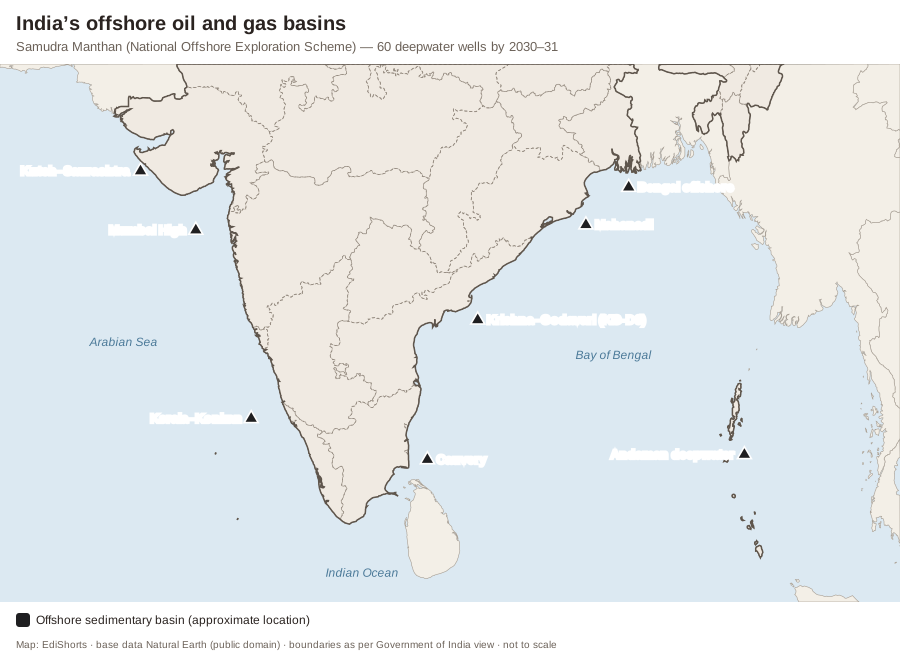
Scheme Components
- Seismic data acquisition — ₹28,534 crore, to map frontier offshore areas.
- Drilling of 60 deepwater exploration wells — ₹43,200 crore; the government shares up to 50% of eligible drilling costs, capped at ₹675 crore per well.
- Shared offshore infrastructure hubs — ₹10,000 crore; manufacturing and service zones — ₹2,000 crore; monitoring — ₹350 crore.
- Central Sector Scheme of the Ministry of Petroleum and Natural Gas.
Why It Matters
- Import dependence: India imports about 88% of its crude oil and about half its natural gas — a big drain on foreign exchange, exposed to price shocks such as the 2026 surge in Brent to over US$ 100.
- Untapped potential: much of India’s 3.36 million sq km of sedimentary area, especially deepwater and the Andaman basin, is little explored.
- De-risking: deepwater wells are costly and risky; public co-funding encourages private and foreign operators.
Challenges
- High geological risk and long gestation (a discovery can take 7–10 years to produce).
- Need for foreign technology and rigs; global oil majors’ shift towards renewables.
- Environmental safeguards for marine ecosystems, especially around the Andaman Islands.
Static Background — Hydrocarbon Exploration in India
- Sedimentary basins: 26 basins; Category-I (established commercial production): Cambay, Assam Shelf, Mumbai Offshore, Krishna–Godavari, Cauvery, Assam–Arakan Fold Belt and Rajasthan.
- Mumbai High: discovered in 1974 by the rig Sagar Samrat — India’s largest oilfield. KG-D6: deepwater gas field in the Krishna–Godavari basin.
- Policy: Hydrocarbon Exploration and Licensing Policy (HELP, 2016) with a single licence for all hydrocarbons, revenue-sharing and the Open Acreage Licensing Policy (OALP) letting companies choose blocks; about 99% of offshore “no-go” areas were opened in 2022.
- Oilfields (Regulation and Development) Amendment Act, 2025: a single “petroleum lease”, longer tenure and stability of terms.
- Regulator: Directorate General of Hydrocarbons (DGH, 1993); National Data Repository for seismic data.
- Deepwater generally means water depth of about 400–1,500 metres; ultra-deepwater beyond 1,500 metres.
| Basin | Location | Note |
|---|---|---|
| Mumbai Offshore | Arabian Sea | Mumbai High, largest oilfield |
| Krishna–Godavari | Bay of Bengal | KG-D6 deepwater gas |
| Cauvery | Tamil Nadu coast | Category-I producer |
| Andaman | Andaman Sea | Frontier deepwater |
Exam Angle — Prelims & Mains
- UPSC PYQ Link: Mains GS-3 has asked about India’s energy security and the HELP policy; Prelims on the location of oil fields.
- Practice Mains Question (GS Paper 3, 10 marks, 150 words): Explain how the Samudra Manthan scheme seeks to de-risk deepwater exploration and assess its potential for India’s energy security.
- Prelims Angle: Category-I basins, Mumbai High and the HELP/OALP framework.
- Practice Prelims MCQ 1: Consider the following statements:1. Under HELP, a single licence covers exploration of conventional and unconventional hydrocarbons.2. Under OALP, exploration blocks are offered only on dates fixed by the government without any role for companies in selecting them.3. Mumbai High is India’s largest oilfield.Which of the statements given above are correct?(A) 1 and 2 only(B) 2 and 3 only(C) 1 and 3 only(D) 1, 2 and 3
Show answer
Answer: (C) 1 and 3 only — Statement 1 is CORRECT. Statement 2 is INCORRECT — OALP lets companies carve out and bid for blocks of their choice throughout the year. Statement 3 is CORRECT. - Practice Prelims MCQ 2: Which one of the following is NOT a Category-I (commercially producing) sedimentary basin of India?(A) Cambay(B) Cauvery(C) Andaman(D) Rajasthan
Show answer
Answer: (C) — The Andaman basin is a frontier area still being explored; Cambay, Cauvery and Rajasthan are producing basins.
- Practice Prelims MCQ 1: Consider the following statements: