Why in News: As air quality in Delhi-NCR slipped into the “poor” range in October 2026, the Commission for Air Quality Management (CAQM) invoked Stage I of the Graded Response Action Plan (GRAP). Analyses during the month asked why stubble fires in Punjab and Haryana keep returning — compressed harvest windows, paddy procurement incentives and costly machinery — and noted that farmers increasingly burn late in the day to evade satellite detection. The Union Science Ministry inaugurated AATAL, an integrated air-pollution analysis facility at IITM’s Delhi centre, and WWF-India launched a Green Diwali drive across National Clean Air Programme cities.
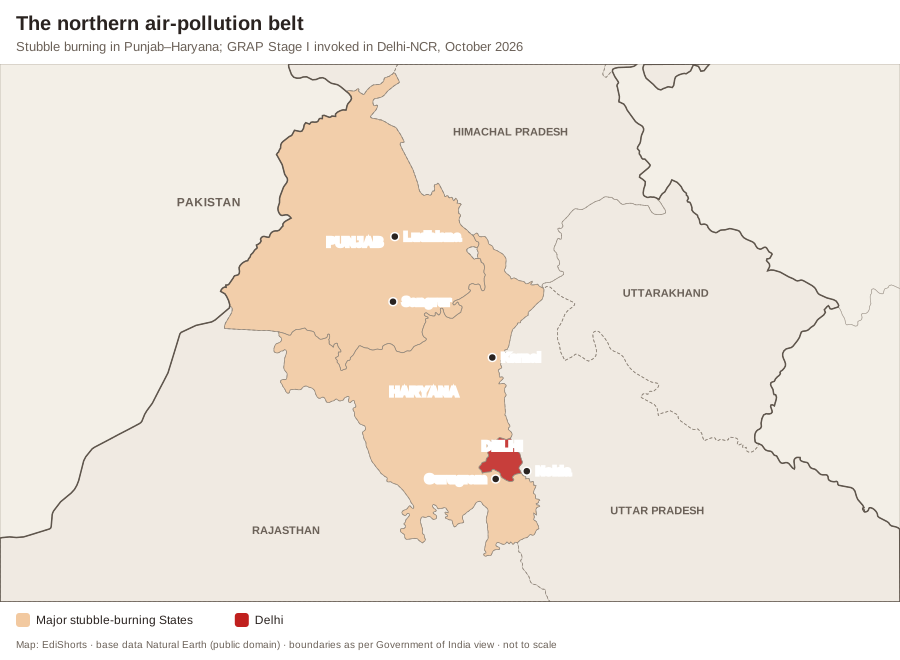
Why Stubble Burning Persists
- Short window: the Punjab Preservation of Subsoil Water Act, 2009 delays paddy transplanting to save groundwater — leaving only two to three weeks between paddy harvest and wheat sowing.
- Combine harvesters leave tall stubble; in-situ options (Happy Seeder, Super Seeder) and ex-situ uses (biomass power, 2G ethanol, pellets) need money and logistics.
- Assured MSP procurement keeps the paddy–wheat cycle attractive despite falling water tables.
- Satellite gaming: fires set after the overpass times of polar-orbiting satellites are missed; geostationary data are now used to correct counts.
The Wider Picture of Delhi’s Air
- Stubble is a seasonal contributor (its share in Delhi’s PM2.5 varies from a few percent to over a third on peak days); vehicles, dust, industry, waste burning and weather (low winds, inversion) matter all winter.
- GRAP stages by AQI: Stage I “poor” (201–300), Stage II “very poor” (301–400), Stage III “severe” (401–450), Stage IV “severe+” (above 450).
New Tools and Measures
- AATAL (IITM): analyses aerosol chemistry and toxicity and apportions sources, feeding the AIRWISE forecasting system.
- Crop Residue Management scheme (machinery subsidies since 2018); bio-decomposer sprays (Pusa decomposer); paddy straw for co-firing in thermal plants.
- National Clean Air Programme (2019): 130 non-attainment cities, target of 40% reduction in particulate concentration by 2025–26 against 2017 levels; funds linked to performance.
Way Forward
- Crop diversification (millets, maize, pulses) with assured procurement; direct-seeded rice to widen the sowing window.
- A market for straw — balers, supply chains to biomass plants and compressed biogas units (GOBARdhan).
- Airshed management across States — pollution does not respect boundaries.
Static Background — Air Quality Governance
- Commission for Air Quality Management in NCR and Adjoining Areas Act, 2021 — CAQM replaced the EPCA (1998).
- National Ambient Air Quality Standards (2009): 12 pollutants; National Air Quality Index (2014) uses eight pollutants — PM10, PM2.5, NO2, SO2, CO, O3, NH3 and Pb.
- AQI categories: Good (0–50), Satisfactory (51–100), Moderately polluted (101–200), Poor (201–300), Very poor (301–400), Severe (401–500).
- WHO guideline (2021) for annual PM2.5: 5 µg/m³; India’s NAAQS: 40 µg/m³.
- Stubble burning is punishable with environmental compensation under CAQM rules; the Air (Prevention and Control of Pollution) Act, 1981 was decriminalised in parts by the Jan Vishwas Act, 2023.
| GRAP stage | AQI range |
|---|---|
| Stage I | 201–300 (Poor) |
| Stage II | 301–400 (Very poor) |
| Stage III | 401–450 (Severe) |
| Stage IV | Above 450 (Severe+) |
Exam Angle — Prelims & Mains
- UPSC PYQ Link: Prelims has asked about pollutants included in the AQI; Mains GS-3 on crop-residue burning and its solutions.
- Practice Mains Question (GS Paper 3, 15 marks, 250 words): Stubble burning is a symptom of an unsustainable cropping pattern rather than of farmer indifference. Discuss and suggest a long-term solution.
- Prelims Angle: AQI pollutants, GRAP thresholds, the Punjab subsoil water law.
- Practice Prelims MCQ 1: Which of the following pollutants are included in India’s National Air Quality Index?1. Ammonia2. Lead3. Carbon dioxide4. OzoneSelect the correct answer using the code given below:(A) 1, 2 and 4 only(B) 2, 3 and 4 only(C) 1 and 3 only(D) 1, 2, 3 and 4
Show answer
Answer: (A) 1, 2 and 4 only — Statement 1 is CORRECT, Statement 2 is CORRECT and Statement 4 is CORRECT. Statement 3 is INCORRECT — CO2 is not part of the AQI (carbon monoxide is). - Practice Prelims MCQ 2: The Commission for Air Quality Management in NCR and Adjoining Areas replaced which body?(A) Central Pollution Control Board(B) Delhi Pollution Control Committee(C) National Green Tribunal(D) Environment Pollution (Prevention and Control) Authority
Show answer
Answer: (D) — The Supreme Court-mandated EPCA (1998) was dissolved when the CAQM was set up by statute in 2021.
- Practice Prelims MCQ 1: Which of the following pollutants are included in India’s National Air Quality Index?