Why in News: In mid-October 2026 two more wetlands were designated as Wetlands of International Importance under the Ramsar Convention — Sukhna Wetland in Chandigarh (Ramsar Site No. 2602, the Union Territory’s first) and Sauj Jheel in Mainpuri district, Uttar Pradesh (No. 2603). India now has 103 Ramsar sites covering over 13.87 lakh hectares in 28 States and UTs — up from 26 sites in 2014.
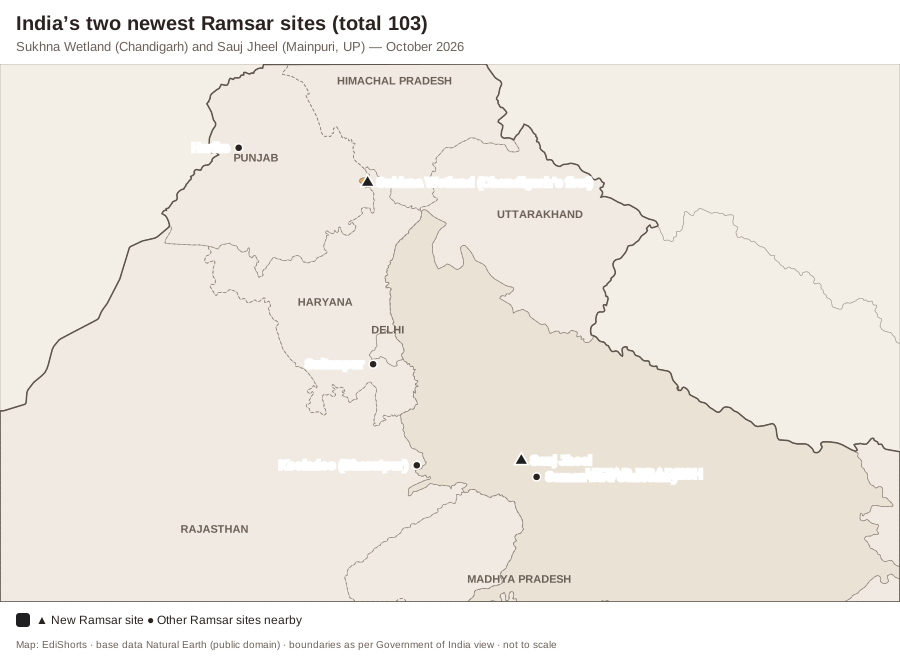
About the New Sites
- Sukhna Wetland: a peri-urban reservoir at the foothills of the Shivaliks (Outer Himalayas), created in 1958 by damming the seasonal Sukhna Choe stream as part of Le Corbusier’s plan for Chandigarh. It hosts wintering waterfowl and faces siltation from the catchment and urban pressure.
- Sauj Jheel: a shallow freshwater lake surrounded by farmland in the Ganga floodplain; a wintering ground for migratory birds such as the sarus crane’s companions and ducks. Mainpuri already had the Saman Bird Sanctuary (Ramsar, 2019).
Why Wetlands Matter
- Ecosystem services: flood control, groundwater recharge, water purification, fisheries and carbon storage — peatlands and mangroves are major carbon sinks.
- Biodiversity: critical for migratory birds on the Central Asian Flyway.
- Threats: encroachment, sewage and solid waste, invasive species (water hyacinth), and altered hydrology; India has lost a large share of its natural wetlands in recent decades.
Static Background — The Ramsar Convention and Wetland Law
- Signed at Ramsar, Iran, on 2 February 1971 (World Wetlands Day); in force 1975. India became a party in 1982; its first sites were Chilika Lake (Odisha) and Keoladeo National Park (Rajasthan), designated in 1981.
- Criteria include supporting threatened species or 20,000 or more waterbirds; designation does not change ownership.
- Montreux Record: sites where ecological change is occurring; Keoladeo and Loktak (Manipur) are listed; Chilika was removed in 2002 after restoration.
- Wetlands (Conservation and Management) Rules, 2017 under the Environment (Protection) Act; State Wetland Authorities notify and regulate wetlands.
- Amrit Dharohar (2023): community-based conservation of Ramsar sites; MISHTI for mangrove plantation.
- Facts: Tamil Nadu has the most Ramsar sites; the Sundarbans (West Bengal) is India’s largest Ramsar site by area.
| Ramsar fact | Detail |
|---|---|
| Convention signed | Ramsar, Iran, 1971 |
| India joined | 1982 |
| First Indian sites | Chilika and Keoladeo (1981) |
| Indian sites on Montreux Record | Keoladeo, Loktak |
| Total (October 2026) | 103 |
Exam Angle — Prelims & Mains
- UPSC PYQ Link: Prelims has asked repeatedly about Ramsar sites and the Montreux Record (e.g., 2014 on wetlands and their States).
- Practice Mains Question (GS Paper 3, 10 marks, 150 words): The rapid growth in India’s Ramsar sites must be matched by better management on the ground. Discuss the threats to urban wetlands with suitable examples.
- Prelims Angle: new sites’ locations, first sites, Montreux Record.
- Practice Prelims MCQ 1: Consider the following pairs:1. Sukhna Wetland — Chandigarh2. Sauj Jheel — Rajasthan3. Saman Bird Sanctuary — Uttar PradeshHow many of the pairs given above are correctly matched?(A) Only one(B) Only two(C) All three(D) None
Show answer
Answer: (B) Only two — Pair 1 is correct and pair 3 is correct. Pair 2 is incorrect — Sauj Jheel is in Mainpuri, Uttar Pradesh. - Practice Prelims MCQ 2: Which of the following Indian wetlands are currently on the Montreux Record?1. Keoladeo National Park2. Loktak Lake3. Chilika LakeSelect the correct answer using the code given below:(A) 1 and 2 only(B) 2 and 3 only(C) 1 and 3 only(D) 1, 2 and 3
Show answer
Answer: (A) 1 and 2 only — Statement 1 is CORRECT and Statement 2 is CORRECT. Statement 3 is INCORRECT — Chilika was removed from the Montreux Record in 2002.
- Practice Prelims MCQ 1: Consider the following pairs: