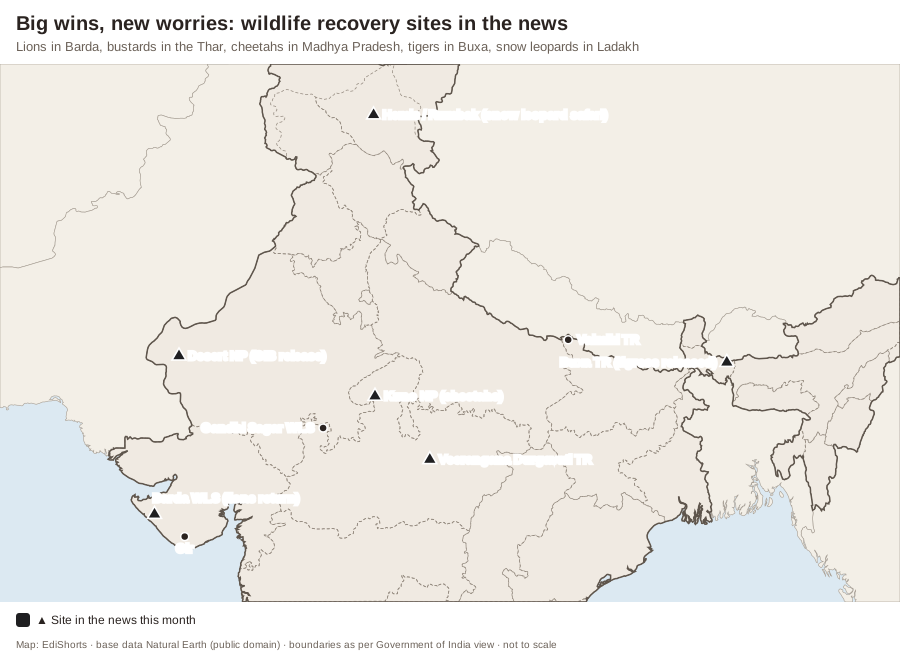
Why in News: October 2026 brought a cluster of conservation milestones and one grim first. Two captive-bred Great Indian Bustards (GIBs) were released into the wild at Desert National Park (4 October); Ladakh launched India’s first high-altitude snow leopard safari (7 October); a study confirmed that Asiatic lions have reclaimed Gujarat’s Barda Wildlife Sanctuary after about 144 years; a tigress translocated from Valmiki was released in Buxa; and a 19-month-old cheetah, KNG22, died of gunshot wounds outside Kuno National Park — the first known killing of a cheetah by firearm since the reintroduction began.
The Stories in Brief
- Great Indian Bustard: the two males released at Sam came from the conservation-breeding centres at Sam and Ramdevra, which hold about 97 birds (57 bred in captivity). It marks a shift from breeding to rewilding; survival of the released birds will be tracked.
- Asiatic lions in Barda: a PLOS One study (September 2026), based on six radio-collared lions, found adequate prey and habitat; Barda now holds 17 lions and is “Satellite Population 8” under Project Lion. Gujarat’s lions numbered 891 in 2025, with only 394 in the Gir core — most now live outside it.
- Cheetah KNG22: found injured in the Morena forest on 25 October with pellets in its body, died two days later; the Centre sent a high-level team. India’s cheetah count fell to 58 — 52 at Kuno, four at Gandhi Sagar and two at Veerangana Durgavati Tiger Reserve.
- Snow leopard safari: six open vehicles on routes at Rumbak, Shang and Uley near Hemis National Park — a community-based ecotourism model. India’s first national assessment (SPAI, released 2024) estimated 718 snow leopards, 477 of them in Ladakh.
- Buxa: a tigress from Bihar’s Valmiki Tiger Reserve was released to help revive tigers in north Bengal’s Buxa reserve.
The Bigger Picture
- Successes: species-specific projects (Project Lion, Project GIB, Project Cheetah) and translocations are expanding ranges.
- Risks: as animals move beyond protected areas, they meet guns, roads, power lines and angry farmers — the KNG22 case shows protection must extend to corridors and buffer villages.
- Power lines kill GIBs; the Supreme Court’s orders since 2021 on undergrounding lines in priority habitat seek a balance with renewable energy.
Static Background — Species and Projects
- Great Indian Bustard: IUCN Critically Endangered; Schedule I of the Wild Life (Protection) Act, 1972; CMS Appendix I; State bird of Rajasthan; fewer than about 150 in the wild.
- Asiatic lion: the Asiatic subpopulation is assessed as Endangered by IUCN; Gir National Park (1965); Project Lion launched in 2020 (Lion@47 vision).
- Cheetah: declared extinct in India in 1952; Project Cheetah began on 17 September 2022 with animals from Namibia, later South Africa; Gandhi Sagar became the second site in 2025.
- Snow leopard: IUCN Vulnerable; Project Snow Leopard (2009); Global Snow Leopard and Ecosystem Protection Programme (GSLEP, Bishkek, 2013) with 12 range countries; International Snow Leopard Day on 23 October. Hemis is India’s largest national park.
- Veerangana Durgavati Tiger Reserve: Madhya Pradesh’s seventh tiger reserve (2023), formed from the Nauradehi and Durgavati sanctuaries.
| Species | IUCN status | Key site in the news |
|---|---|---|
| Great Indian Bustard | Critically Endangered | Desert National Park, Rajasthan |
| Asiatic lion | Endangered (Asiatic subpopulation) | Barda, Gujarat |
| Cheetah | Vulnerable | Kuno, Madhya Pradesh |
| Snow leopard | Vulnerable | Hemis–Rumbak, Ladakh |
Exam Angle — Prelims & Mains
- UPSC PYQ Link: Prelims has asked about the GIB’s habitat and status, and the location of national parks.
- Practice Mains Question (GS Paper 3, 15 marks, 250 words): Species recovery programmes in India are succeeding inside protected areas but face new risks outside them. Discuss with examples from recent developments.
- Prelims Angle: statuses, parks and the States they are in.
- Practice Prelims MCQ 1: Consider the following statements:1. The Great Indian Bustard is listed as Critically Endangered on the IUCN Red List.2. Gandhi Sagar Wildlife Sanctuary is the second site for cheetah reintroduction in India.3. Barda Wildlife Sanctuary is located in Rajasthan.Which of the statements given above are correct?(A) 1 and 2 only(B) 2 and 3 only(C) 1 and 3 only(D) 1, 2 and 3
Show answer
Answer: (A) 1 and 2 only — Statement 1 is CORRECT and Statement 2 is CORRECT. Statement 3 is INCORRECT — Barda is in Gujarat, near Porbandar. - Practice Prelims MCQ 2: Which is the largest national park in India by area?(A) Gangotri National Park(B) Namdapha National Park(C) Desert National Park(D) Hemis National Park
Show answer
Answer: (D) — Hemis in Ladakh (about 4,400 sq km), a stronghold of the snow leopard, is the largest; Desert National Park (about 3,162 sq km) comes next.
- Practice Prelims MCQ 1: Consider the following statements: