Why in News: On 22 October 2026 the International Union for Conservation of Nature (IUCN) published the first global assessment of coral reef ecosystems under its Red List of Ecosystems. It found 122 of 127 reef ecosystems — 96%, covering 99.8% of assessed reef area — to be Critically Endangered when projected marine heatwaves are considered. One, the Western Galápagos, has already collapsed. Even on observed trends alone (excluding climate projections), 91% are threatened.
Key Findings
- Driver: increasingly frequent and severe marine heatwaves cause mass bleaching faster than reefs can recover.
- The world has just gone through the fourth global bleaching event (2023–25), which affected over 80% of reef areas.
- Exceptions: the Northern Red Sea, with unusual heat tolerance, would be only Vulnerable on recent trends.
- “Critically Endangered” does not mean dead — most reefs still have living coral; it signals a very high risk of collapse within 50 years without action.
Why Reefs Matter
- Cover under 1% of the ocean floor but support about a quarter of marine species.
- Protect coasts from waves and storm surges; sustain fisheries and tourism for hundreds of millions of people.
- Sources of new medicines.
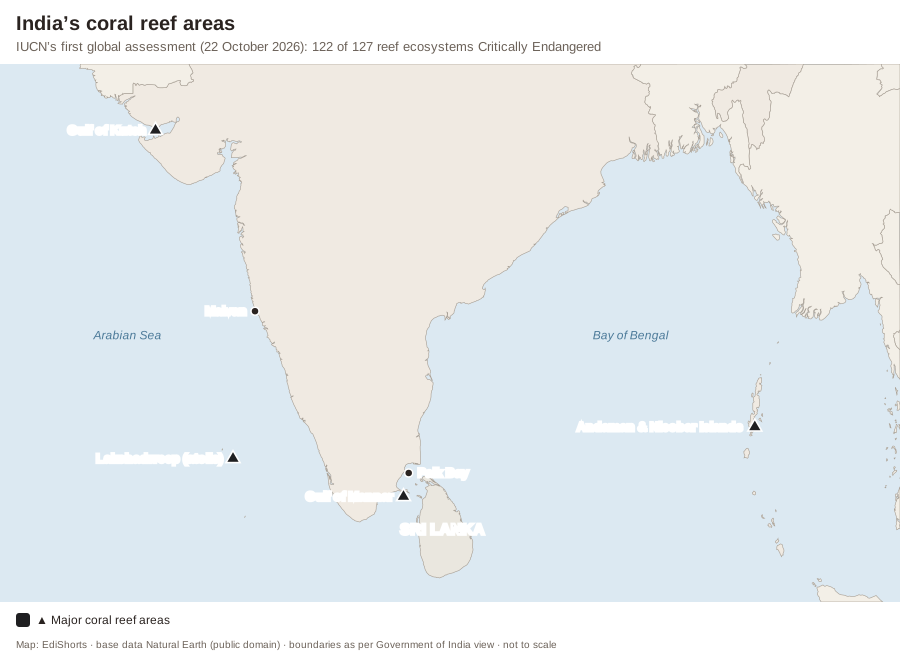
India’s Reefs and Risks
- Reefs in India face bleaching (notably in Lakshadweep and the Gulf of Mannar in 2024), sedimentation, coastal development, overfishing and coral mining in the past.
- Positive efforts: coral transplantation in the Gulf of Kutch (with ZSI and the Gujarat Forest Department), restoration in the Gulf of Mannar and research by NIO.
Way Forward
- Deep emission cuts — the only lasting solution.
- Local resilience: reduce pollution and overfishing, protect herbivorous fish, expand marine protected areas, assist heat-tolerant corals and restoration.
- Coral reef monitoring under ICRI and India’s coastal programmes (National Coastal Mission, ICZM).
Static Background — Corals
- Corals are colonies of tiny animals (polyps) of the phylum Cnidaria that secrete calcium carbonate skeletons. Reef-building corals host symbiotic algae (zooxanthellae) that provide food and colour.
- Bleaching: under heat stress, corals expel zooxanthellae and turn white; prolonged bleaching causes death.
- Conditions: warm (about 20–29°C), clear, shallow, saline waters; mostly between 30°N and 30°S.
- Reef types: fringing (close to shore, e.g., Andamans), barrier (separated by a lagoon, e.g., Great Barrier Reef), atolls (ring-shaped around a lagoon, e.g., Lakshadweep).
- Protection in India: all reef-building corals are in Schedule I of the Wild Life (Protection) Act; Gulf of Kutch Marine National Park (1982) was India’s first marine national park; Gulf of Mannar is a Marine National Park and Biosphere Reserve (1989).
- IUCN Red List of Ecosystems categories: Collapsed, Critically Endangered, Endangered, Vulnerable, Near Threatened, Least Concern, Data Deficient, Not Evaluated.
| Reef type | Example |
|---|---|
| Fringing | Andaman and Nicobar Islands |
| Barrier | Great Barrier Reef (Australia) |
| Atoll | Lakshadweep |
| Patch | Malvan (Maharashtra) |
Exam Angle — Prelims & Mains
- UPSC PYQ Link: Prelims has asked about the location of coral reefs in India (2014); Mains GS-1 on the distribution of reefs and their threats.
- Practice Mains Question (GS Paper 1, 10 marks, 150 words): Explain the formation of coral reefs and why marine heatwaves pose an existential threat to them, with reference to India’s reef areas.
- Prelims Angle: reef types, Indian locations and the biology of bleaching.
- Practice Prelims MCQ 1: Consider the following statements:1. Coral bleaching occurs when corals expel their symbiotic algae under stress.2. Atolls are the dominant reef type in Lakshadweep.3. Reef-building corals are listed in Schedule I of the Wild Life (Protection) Act, 1972.Which of the statements given above are correct?(A) 1 and 2 only(B) 2 and 3 only(C) 1 and 3 only(D) 1, 2 and 3
Show answer
Answer: (D) 1, 2 and 3 — Statement 1 is CORRECT, Statement 2 is CORRECT and Statement 3 is CORRECT. - Practice Prelims MCQ 2: India’s first Marine National Park was established in:(A) Gulf of Mannar(B) Malvan(C) Mahatma Gandhi Marine National Park, Andamans(D) Gulf of Kutch
Show answer
Answer: (D) — The Marine National Park, Gulf of Kutch (Gujarat), was declared in 1982.
- Practice Prelims MCQ 1: Consider the following statements: