Why in News: On 29 October 2026 a glacial lake outburst flood (GLOF) from Shintaphu Lake in Bhutan’s Gasa district — on Bhutan’s list of 17 potentially dangerous glacial lakes — washed away the Gasa Tshachu hot-spring complex and damaged the Punakha–Gasa highway. The flood travelled down the Mo Chhu and Punatsangchhu, which enters India as the Sankosh; the Central Water Commission issued flash-flood advisories for Alipurduar (West Bengal) and Dhubri (Assam), and thousands were moved to safety. Earlier, on 11 October, a flash flood in Nepal’s Gorkha district swept away over 35 houses, and Nepal received the first allocation from the Loss and Damage Fund for the August Bhote Koshi ice-and-rock avalanche flood.
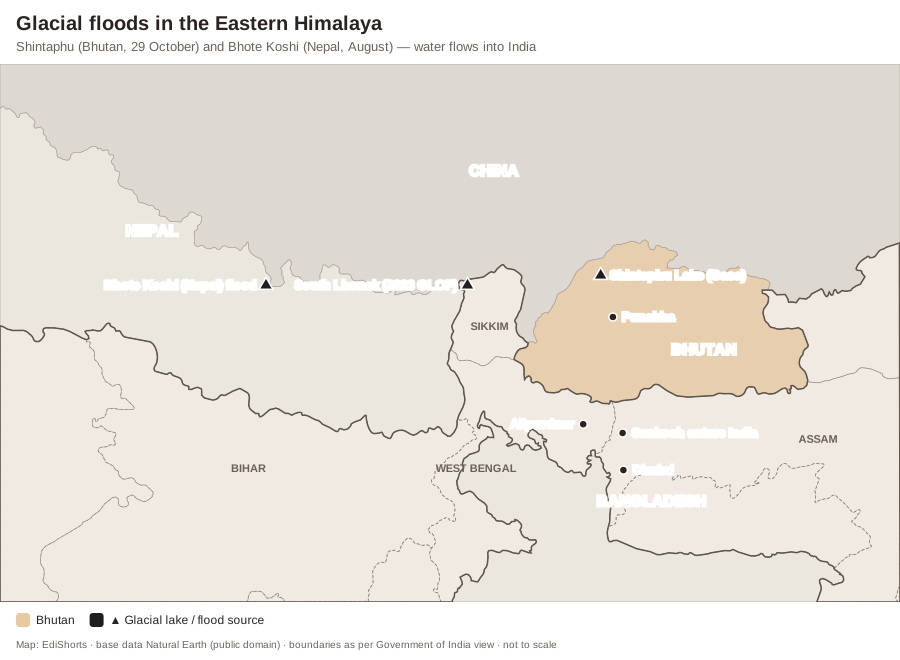
What a GLOF Is
- As glaciers retreat, meltwater collects in lakes held back by loose moraines (rock debris) or ice. A trigger — an avalanche or landslide into the lake, heavy rain, an earthquake or the moraine’s failure — releases the water suddenly, sending a wall of water and debris downstream.
- Damage spreads tens to hundreds of kilometres — across borders — destroying roads, dams and villages.
- Example in India: the South Lhonak lake outburst in Sikkim (October 2023) destroyed the Teesta-III (Chungthang) dam and killed dozens.
Why the Risk Is Rising
- Himalayan glaciers are melting faster (ICIMOD estimates they could lose up to 80% of volume by 2100 under high warming); new and expanding lakes multiply.
- More infrastructure (hydropower, roads, tourism) in the valleys increases exposure.
India’s Response
- NDMA guidelines on GLOFs (2020); National GLOF Risk Mitigation Programme — risk assessment, automated weather and water-level stations, early warning, lake lowering (siphoning) and community preparedness for high-risk lakes in the Himalayan States.
- Satellite monitoring of glacial lakes by the Central Water Commission and NRSC (ISRO).
- Cross-border data sharing with Bhutan and Nepal is vital — Indian downstream districts got warnings within hours in this case.
Static Background — Himalayan Glaciers and Rivers
- Major glaciers: Siachen (Karakoram), Gangotri (source of the Bhagirathi, Uttarakhand), Zemu (Sikkim), Milam.
- Bhutan’s rivers flowing into India: Amo Chhu (Torsa), Wang Chhu (Raidak), Punatsangchhu (Sankosh), Mangde Chhu and Drangme Chhu (Manas) — all join the Brahmaputra.
- ICIMOD (International Centre for Integrated Mountain Development): Kathmandu-based, eight member countries of the Hindu Kush Himalaya, including India.
- Hindu Kush Himalaya is called the “Third Pole” — the largest store of ice outside the polar regions.
| Event | Year | Place |
|---|---|---|
| Kedarnath (Chorabari lake breach) | 2013 | Uttarakhand |
| Chamoli rock–ice avalanche | 2021 | Uttarakhand |
| South Lhonak GLOF | 2023 | Sikkim |
| Shintaphu GLOF | 2026 | Bhutan (warnings in Bengal, Assam) |
Exam Angle — Prelims & Mains
- UPSC PYQ Link: Mains GS-1 has asked about the causes and impacts of cloudbursts and Himalayan floods; Prelims on Himalayan rivers and glaciers.
- Practice Mains Question (GS Paper 3, 15 marks, 250 words): Glacial lake outburst floods are a transboundary hazard. Discuss India’s preparedness and the need for regional cooperation.
- Prelims Angle: GLOF mechanism, Bhutan rivers and ICIMOD.
- Practice Prelims MCQ 1: Consider the following statements:1. A GLOF can be triggered by an avalanche falling into a glacial lake.2. Moraine-dammed lakes are more stable than lakes dammed by bedrock.3. The South Lhonak lake outburst of 2023 damaged a dam on the Teesta river.Which of the statements given above are correct?(A) 1 and 2 only(B) 2 and 3 only(C) 1 and 3 only(D) 1, 2 and 3
Show answer
Answer: (C) 1 and 3 only — Statement 1 is CORRECT and Statement 3 is CORRECT. Statement 2 is INCORRECT — moraine dams of loose debris are among the most prone to failure. - Practice Prelims MCQ 2: The Punatsangchhu river of Bhutan enters India under which name?(A) Torsa(B) Raidak(C) Sankosh(D) Manas
Show answer
Answer: (C) — It flows into the Assam–West Bengal border region as the Sankosh and joins the Brahmaputra.
- Practice Prelims MCQ 1: Consider the following statements: