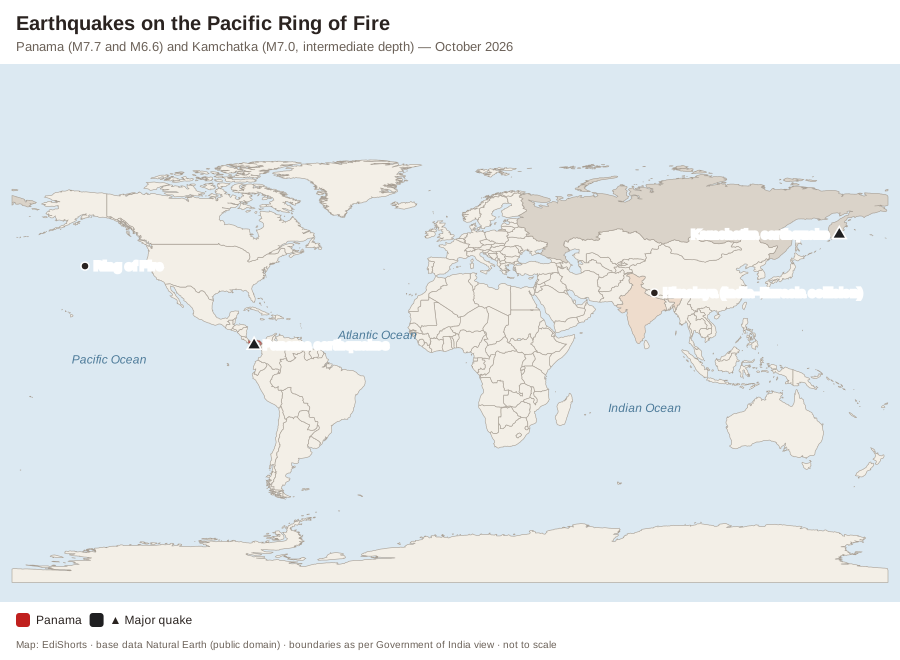
Why in News: In mid-October 2026 earthquakes of magnitude 7.7 and 6.6 struck southern Panama, damaging nearly 900 homes and schools and prompting a national emergency. Days later a magnitude 7.0 earthquake struck off Russia’s volcanic Kamchatka Peninsula at an intermediate depth of about 130–152 km. Both lie on the Pacific “Ring of Fire”. Kamchatka was also the site of a magnitude 8.8 megathrust earthquake in July 2025 that triggered Pacific-wide tsunami alerts.
Why These Places Shake
- Panama sits at the junction of the Cocos, Nazca, Caribbean and South American plates and the Panama micro-plate — a complex zone of subduction and transform faults.
- Kamchatka lies where the Pacific plate subducts beneath the Okhotsk plate along the Kuril–Kamchatka trench; deep subduction produces intermediate-depth quakes and a chain of active volcanoes (Klyuchevskaya Sopka).
- Intermediate and deep quakes usually cause less surface damage than shallow ones of the same magnitude because energy dissipates over distance.
Lessons for India
- The Himalaya is one of the most seismically active continental collision zones; a “great” earthquake (M8+) is overdue in parts of the central Himalaya (the “seismic gap”).
- Delhi, the north-east and the Kutch region are high-risk; most building stock is not earthquake-resistant.
- Need: enforcement of BIS seismic codes, retrofitting of schools and hospitals, earthquake early warning (Uttarakhand’s “Bhukamp Alert” app), and urban search-and-rescue capacity (NDRF).
Static Background — Earthquakes
- Focus (hypocentre) — where rupture starts; epicentre — point on the surface above it.
- Depth: shallow (0–70 km), intermediate (70–300 km), deep (300–700 km).
- Seismic waves: P-waves (primary, longitudinal, travel through solids and liquids, fastest); S-waves (secondary, transverse, only through solids — their shadow zone revealed the liquid outer core); surface waves (Love and Rayleigh) cause most damage.
- Magnitude (energy released — Richter, now moment magnitude scale; each whole number is about 32 times more energy) vs intensity (effects, Modified Mercalli scale).
- Ring of Fire: about 90% of the world’s earthquakes and 75% of active volcanoes occur around the Pacific.
- India’s seismic zones under the BIS code: Zone V (most severe) includes the north-east, J&K, Himachal, Uttarakhand, Kutch, north Bihar and the Andaman and Nicobar Islands.
| Wave | Type | Travels through |
|---|---|---|
| P-wave | Longitudinal (compressional) | Solids, liquids, gases |
| S-wave | Transverse (shear) | Solids only |
| Surface waves | Love and Rayleigh | Along the surface |
Exam Angle — Prelims & Mains
- UPSC PYQ Link: Prelims has asked about P- and S-waves and their shadow zones; Mains GS-1 on the distribution of earthquakes and volcanoes along plate boundaries.
- Practice Mains Question (GS Paper 1, 10 marks, 150 words): Why are subduction zones associated with the most powerful earthquakes and tsunamis? Explain with examples.
- Prelims Angle: waves, depth categories and zones.
- Practice Prelims MCQ 1: Consider the following statements:1. S-waves cannot travel through liquids.2. The epicentre is the point inside the Earth where the rupture begins.3. An increase of one unit on the moment magnitude scale corresponds to about 32 times more energy.Which of the statements given above are correct?(A) 1 and 2 only(B) 2 and 3 only(C) 1 and 3 only(D) 1, 2 and 3
Show answer
Answer: (C) 1 and 3 only — Statement 1 is CORRECT and Statement 3 is CORRECT. Statement 2 is INCORRECT — that is the focus (hypocentre); the epicentre is the surface point above it. - Practice Prelims MCQ 2: An earthquake with a focus 140 km deep would be classified as:(A) shallow-focus(B) intermediate-focus(C) deep-focus(D) surface-focus
Show answer
Answer: (B) — Foci between about 70 and 300 km are intermediate.
- Practice Prelims MCQ 1: Consider the following statements: