Why in News: A security agreement signed by the United States, Denmark and Greenland on 22 September 2026 at the UN General Assembly expands the US military presence on the world’s largest island while affirming Danish sovereignty and Greenland’s right to self-determination. An editorial in late October argued that the deal eases a year of tension over Washington’s interest in acquiring Greenland but “is not the end of the Arctic contest”. The agreement needs approval from the parliaments of Denmark and Greenland.
What the Agreement Provides
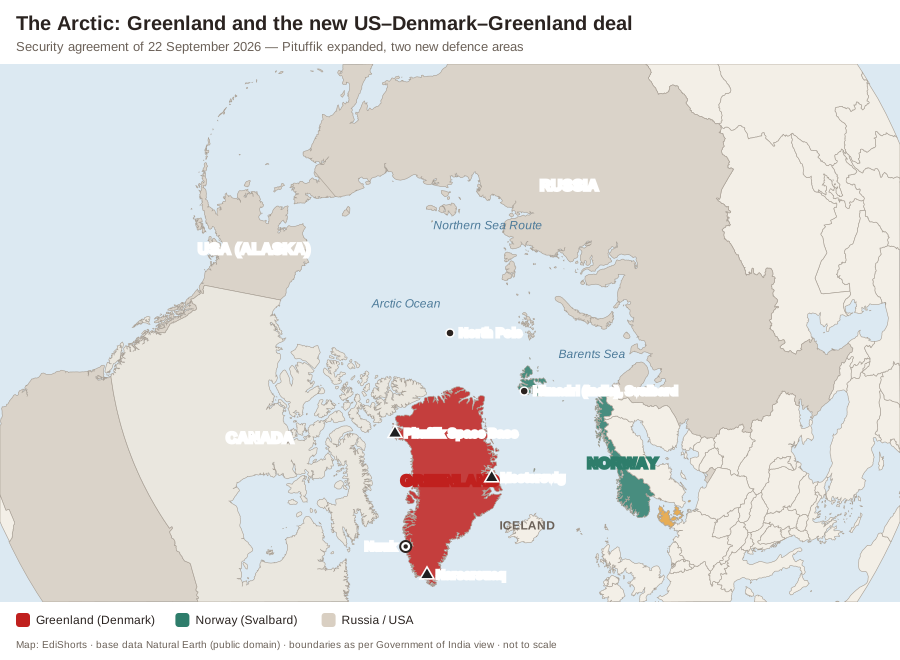
- Modernisation and enlargement of the Pituffik Space Base (formerly Thule) and two new defence areas — Narsarsuaq (south) and Mestersvig (east coast).
- Overflight, landing and undersea access for US aircraft and vessels across Greenland, including its territorial waters.
- No non-NATO country can set up military installations or a “persistent” presence without the unanimous approval of the US, Denmark and Greenland.
- No expiry date; it survives even if Greenland becomes independent. Troop numbers, timelines and minerals are not covered.
Why the Arctic Is Contested
- Melting ice: the Arctic is warming nearly four times faster than the global average; September 2026 sea-ice minimum was 4.6 million sq km — among the lowest on record.
- Shipping routes: the Northern Sea Route along Russia’s coast and the Northwest Passage through Canada’s archipelago shorten Europe–Asia voyages.
- Resources: an estimated 13% of undiscovered oil and 30% of undiscovered gas; rare earths in Greenland.
- Security: the GIUK (Greenland–Iceland–UK) gap for submarines, missile-warning radars, and Russian and Chinese activity (China calls itself a “near-Arctic state”).
India’s Stakes
- Climate science: Arctic change affects the Indian monsoon and sea levels; Himadri at Ny-Ålesund (2008) and the IndARC moored observatory (2014) study it.
- Shipping: shorter routes could change trade patterns, including Russian LNG and the Chennai–Vladivostok corridor linking with the Northern Sea Route.
- Strategy: balancing ties with the US, Russia and Nordic partners; India–Nordic Summits (2018, 2022).
Way Forward
- Strengthen the Arctic Council and environmental safeguards; avoid militarisation spilling into the scientific commons.
- Expand India’s research presence and polar research vessel plans; partner with Nordic countries on green shipping and critical minerals.
Static Background — The Arctic and India
- Arctic Council (Ottawa Declaration, 1996): eight members — Canada, Denmark (for Greenland and the Faroe Islands), Finland, Iceland, Norway, Russia, Sweden and the USA; six indigenous Permanent Participants. India became an Observer in 2013 (with China, Japan, South Korea, Singapore and Italy).
- Svalbard Treaty (1920): recognises Norwegian sovereignty but gives signatories equal rights to economic activity; India is a party (signed by British India).
- India’s Arctic Policy (2022): six pillars — science and research, climate and environmental protection, economic and human development, transportation and connectivity, governance and international cooperation, national capacity building.
- Greenland: autonomous territory of the Kingdom of Denmark; Home Rule (1979), Self-Government Act (2009) — Greenland controls domestic affairs and can claim independence; Denmark keeps foreign, defence and security policy. Capital Nuuk.
- Indian polar stations: Himadri (Arctic, Svalbard), Maitri and Bharati (Antarctica); Dakshin Gangotri (Antarctica, 1983, now a supply base).
| Arctic term | Meaning |
|---|---|
| Northern Sea Route | Russian Arctic coast, Barents to Bering Strait |
| Northwest Passage | Through the Canadian Arctic Archipelago |
| GIUK gap | Greenland–Iceland–UK naval chokepoint |
| Svalbard Treaty | 1920; Norway’s sovereignty, equal economic rights |
Exam Angle — Prelims & Mains
- UPSC PYQ Link (Mains 2018, GS Paper 1): Why is India taking keen interest in resources of Arctic Region?
- UPSC PYQ Link (Prelims 2014): which of Denmark, Japan, Russia, UK and USA are members of the Arctic Council — answer: Denmark, Russia and the USA.
- Practice Mains Question (GS Paper 2, 15 marks, 250 words): The Arctic is turning from a zone of cooperation into an arena of strategic competition. Discuss the implications for India and the role it should play.
- Prelims Angle: Arctic Council members and observers, Svalbard, India’s polar stations.
- Practice Prelims MCQ 1: Consider the following statements:1. India is a member of the Arctic Council.2. India’s Arctic research station Himadri is located in Svalbard.3. Greenland is a member of the European Union.Which of the statements given above is/are correct?(A) 1 only(B) 2 only(C) 2 and 3 only(D) 1, 2 and 3
Show answer
Answer: (B) 2 only — Statement 1 is INCORRECT — India is an Observer (since 2013), not a member. Statement 2 is CORRECT — Himadri is at Ny-Ålesund, Svalbard. Statement 3 is INCORRECT — Greenland left the European Communities in 1985 after a referendum. - Practice Prelims MCQ 2: The Northern Sea Route connects which two water bodies along the coast of Russia?(A) Baltic Sea and Black Sea(B) North Sea and Laptev Sea(C) Caspian Sea and Sea of Okhotsk(D) Barents Sea and Bering Strait
Show answer
Answer: (D) — The route runs from the Barents (Kara Gate) to the Bering Strait along Russia’s Arctic coast.
- Practice Prelims MCQ 1: Consider the following statements: