Why in News: Israel voted on 27 October 2026 in its first general election since the Hamas attack of 7 October 2023 and the Gaza war. With all votes counted, Prime Minister Benjamin Netanyahu’s Likud remained the largest party (27 seats) but his right-religious bloc won only 53 of the 120 Knesset seats; the bloc led by former army chief Gadi Eisenkot (whose Yashar party won 21) got 48, and Arab parties won a record 19. No bloc has the 61 seats needed for a majority; the new Knesset is to be sworn in on 10 November.
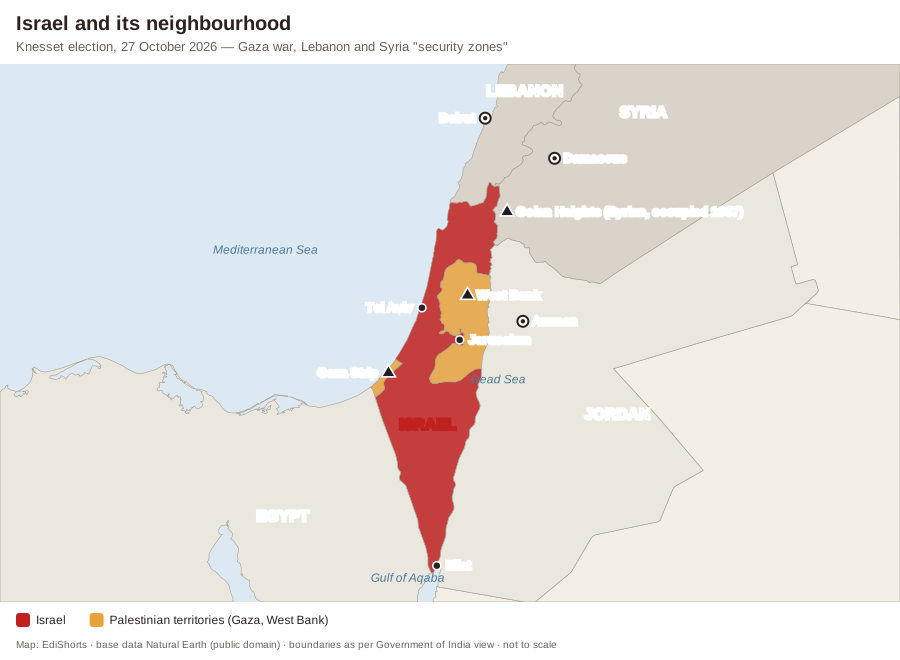
Key Takeaways from the Result
- A referendum without a verdict: voters punished the security failure of 7 October but did not reject Netanyahu decisively — he seeks a seventh term.
- Arab parties as kingmakers: the Joint List and Ra’am together won 19 seats — the highest ever — making them pivotal for any non-Netanyahu government (Ra’am joined a coalition once before, in 2021).
- Far-right resilience: Otzma Yehudit and Religious Zionism kept a significant presence, constraining any Netanyahu-led coalition.
- Continuity on core issues: Netanyahu and Eisenkot differ on the judiciary and on military exemptions for ultra-Orthodox (Haredi) men, but both oppose Palestinian statehood and favour “security zones” in Lebanon and Syria.
Regional Stakes
- Gaza: over 70,000 Palestinians have been killed, about 20,000 of them children; reconstruction and governance of Gaza remain unresolved.
- Iran: reports suggest the US and Israel are preparing fresh strikes on Iran after the US mid-term elections (3 November); the war-linked energy shock has global effects.
- Normalisation: any Saudi–Israel deal depends on a credible pathway to a Palestinian state.
India’s Interests
- Strategic partner: defence (India is among Israel’s largest arms buyers), agriculture and water technology, and a Bilateral Investment Agreement (2025).
- Connectivity: the India–Middle East–Europe Economic Corridor (IMEC, 2023) and Adani’s Haifa port depend on regional stability.
- Diaspora and labour: thousands of Indian workers went to Israel under government-to-government arrangements after 2023.
- Balance: India condemned the 7 October terror attack, sent humanitarian aid to Gaza, and supports a negotiated two-State solution with a sovereign, viable Palestine.
Way Forward for India
- Keep the de-hyphenated policy — independent ties with Israel and with Palestine and the Arab world.
- Use its standing with both sides to support humanitarian access and reconstruction.
- Protect energy and shipping interests (Red Sea, Strait of Hormuz) through diversification and naval presence.
Static Background — Israel, Palestine and India’s Policy
- Israel’s system: a parliamentary democracy without a single written constitution (governed by Basic Laws); the 120-member Knesset is elected by nationwide closed-list proportional representation with a 3.25% threshold; the President (Isaac Herzog) asks a member to form a government.
- Key dates: 1948 — creation of Israel; 1967 — Six-Day War (Israel occupied the West Bank, Gaza, East Jerusalem, Golan Heights and Sinai); 1979 — Egypt–Israel peace treaty; 1993 — Oslo Accords; 1994 — Jordan–Israel treaty; 2020 — Abraham Accords with the UAE and Bahrain (later Morocco and Sudan).
- India and Palestine: India recognised the PLO as the sole representative of the Palestinian people (1974) and recognised the State of Palestine in 1988 — among the first non-Arab countries; it has a Representative Office in Ramallah.
- India and Israel: India recognised Israel in 1950; full diplomatic relations only in 1992. PM Modi made the first prime-ministerial visit to Israel in 2017.
- I2U2 (India, Israel, UAE, USA) launched in 2021–22 for joint investment in food security, water, energy, space, health and transport.
| Accord | Year | Parties |
|---|---|---|
| Camp David / Egypt–Israel Treaty | 1978–79 | Egypt, Israel (US-brokered) |
| Oslo Accords | 1993 | Israel, PLO |
| Abraham Accords | 2020 | Israel with UAE, Bahrain (later Morocco, Sudan) |
| Arab Peace Initiative | 2002 | Arab League proposal; not signed by Israel |
Exam Angle — Prelims & Mains
- UPSC PYQ Link (Mains 2022, GS Paper 2): How will I2U2 (India, Israel, UAE and USA) grouping transform India’s position in global politics?
- UPSC PYQ Link (Prelims 2023): Statement-I: Israel has established diplomatic relations with some Arab States; Statement-II: the “Arab Peace Initiative” mediated by Saudi Arabia was signed by Israel and the Arab League — Statement-I correct, Statement-II incorrect.
- Practice Mains Question (GS Paper 2, 15 marks, 250 words): India’s West Asia policy has moved from “balancing” to “de-hyphenation”. Evaluate this approach in the light of the Gaza war and political change in Israel.
- Prelims Angle: regions and treaties of West Asia, the Knesset system and India’s recognition dates.
- Practice Prelims MCQ 1: Consider the following pairs:1. Golan Heights — occupied by Israel from Syria in 19672. Gaza Strip — borders Egypt3. West Bank — borders LebanonHow many of the pairs given above are correctly matched?(A) Only one(B) Only two(C) All three(D) None
Show answer
Answer: (B) Only two — Pair 1 is correct — Israel captured the Golan from Syria in the 1967 war. Pair 2 is correct — Gaza borders Egypt’s Sinai at Rafah. Pair 3 is incorrect — the West Bank borders Jordan, not Lebanon. - Practice Prelims MCQ 2: Consider the following statements:1. India recognised the State of Palestine in 1988.2. India established full diplomatic relations with Israel in 1992.3. The Abraham Accords normalised relations between Israel and Saudi Arabia.Which of the statements given above are correct?(A) 1 and 2 only(B) 2 and 3 only(C) 1 and 3 only(D) 1, 2 and 3
Show answer
Answer: (A) 1 and 2 only — Statement 1 is CORRECT and Statement 2 is CORRECT. Statement 3 is INCORRECT — the 2020 Accords were with the UAE and Bahrain (later Morocco and Sudan); Saudi Arabia has not normalised ties.
- Practice Prelims MCQ 1: Consider the following pairs: