Why in News: Two years after the October 2024 patrolling arrangement at Depsang and Demchok ended the standoff that began in 2020, India–China relations remain a fragile “managed coexistence”, an editorial argued on 31 October 2026. The same month China’s Ministry of Commerce and Ministry of Science and Technology released Announcement No. 48 (16 October 2026) — a draft that adds 40 technologies to China’s export-control catalogue (23 in artificial intelligence, 12 in solar photovoltaics, 5 in biomedicine; 14 to be prohibited and 26 restricted), with comments open till 15 November. It could hit India’s plans to cut dependence on Chinese solar and pharma inputs.
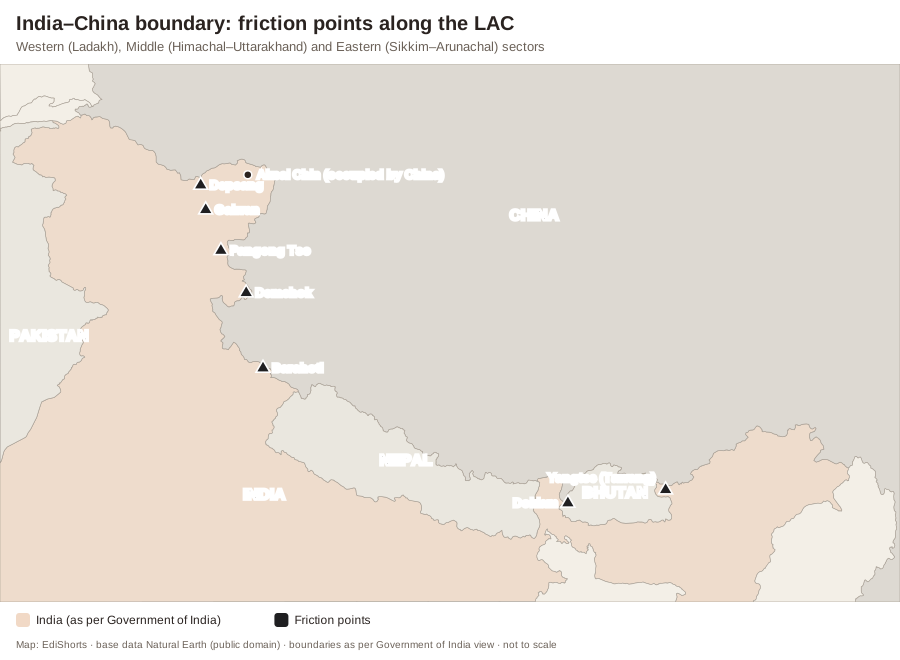
The Thaw Since 2024
- October 2024: patrolling and grazing restored at Depsang and Demchok; PM Modi and President Xi met at Kazan.
- 2025: Kailash Mansarovar Yatra resumed; direct flights restarted; PM Modi attended the SCO summit at Tianjin; the Special Representatives agreed on an expert group to explore “early harvest” in boundary delimitation.
- Buffer zones created during disengagement (Galwan, Pangong, Gogra–Hot Springs) remain; de-escalation and de-induction of troops have not happened.
Why the Relationship Remains Fragile
- Undefined LAC: differing perceptions across 3,488 km lead to recurring face-offs.
- Trade dependence: India’s trade deficit with China is close to US$ 100 billion; electronics, APIs for medicines and solar components come mainly from China.
- Weaponised supply chains: curbs on rare-earth magnets (2025), and now the proposed limits on next-generation solar technologies (perovskite and tandem cells, large-scale polysilicon engineering) and AI model weights.
- Water: China’s mega-dam on the Yarlung Tsangpo (Brahmaputra) at Medog, begun in 2025, raises downstream concerns; there is no water-sharing treaty, only data-sharing MoUs.
- Strategic overlap: China–Pakistan collaboration, Chinese presence in the Indian Ocean and its blocking of terrorist listings at the UN.
Implications of Announcement No. 48 for India
- China controls 75–95% of the global solar supply chain (91% of polysilicon, over 97% of wafers) — India’s PLI-backed module makers still import cells and wafers.
- Joint ventures and licensing with Chinese firms may need Chinese approval — slowing technology transfer.
- It strengthens the case for diversification through the Minerals Security Partnership, QUAD supply-chain work and partnerships with the EU, Japan and the US.
Way Forward
- Border: work towards clarification of the LAC and complete de-escalation; maintain deterrence through infrastructure (Vibrant Villages Programme, roads and tunnels).
- Economy: selective openness — allow Chinese investment where it builds Indian capacity, under Press Note 3 (2020) scrutiny; build domestic polysilicon-to-module chains.
- Diplomacy: keep the leader-level and SR channels active while coordinating with like-minded partners.
Static Background — The India–China Boundary
- Sectors of the LAC: Western (Ladakh, about 1,597 km), Middle (Himachal Pradesh and Uttarakhand, about 545 km), Eastern (Sikkim and Arunachal Pradesh, about 1,346 km) — total about 3,488 km.
- McMahon Line: agreed between British India and Tibet at the Simla Convention (1914); China rejects it. In the west, India’s claim follows the Johnson Line (1865), which places Aksai Chin in India.
- Panchsheel (1954): the Five Principles of Peaceful Coexistence, in the Agreement on Trade and Intercourse between India and the Tibet region of China.
- Key agreements: 1993 (peace and tranquillity along the LAC), 1996 (military CBMs), 2005 (political parameters and guiding principles), 2012 (WMCC), 2013 (Border Defence Cooperation Agreement).
- Flashpoints: Nathu La (1967), Sumdorong Chu (1986–87), Depsang (2013), Doklam (2017), Galwan (June 2020), Yangtse, Tawang (December 2022).
| Agreement | Year | Purpose |
|---|---|---|
| Panchsheel | 1954 | Five principles of peaceful coexistence |
| Peace and Tranquillity Agreement | 1993 | Maintain status quo along the LAC |
| Political Parameters | 2005 | Framework for boundary settlement |
| WMCC | 2012 | Working Mechanism for Consultation and Coordination |
| BDCA | 2013 | Border Defence Cooperation |
Exam Angle — Prelims & Mains
- UPSC PYQ Link (Mains 2021, GS Paper 2): “The USA is facing an existential threat in the form of a China, that is much more challenging than the erstwhile Soviet Union.” Explain.
- UPSC PYQ Link (Mains 2018, GS Paper 2): on the China–Pakistan Economic Corridor as a cardinal subset of China’s One Belt One Road and India’s concerns.
- Practice Mains Question (GS Paper 2, 15 marks, 250 words): “The absence of war is not the presence of peace.” Examine India–China relations since 2020 and suggest a strategy that combines deterrence, dialogue and economic de-risking.
- Prelims Angle: sectors of the LAC, the Simla Convention and the friction points on the map.
- Practice Prelims MCQ 1: Consider the following pairs:1. Depsang Plains — Ladakh2. Yangtse — Sikkim3. Barahoti — UttarakhandWhich of the pairs given above are correctly matched?(A) 1 and 2 only(B) 2 and 3 only(C) 1 and 3 only(D) 1, 2 and 3
Show answer
Answer: (C) 1 and 3 only — Statement 1 is CORRECT — Depsang is in the Western sector (Ladakh). Statement 2 is INCORRECT — Yangtse is in Tawang district of Arunachal Pradesh. Statement 3 is CORRECT — Barahoti is in Chamoli district, Middle sector. - Practice Prelims MCQ 2: The McMahon Line, which China does not accept, was agreed at which of the following?(A) Treaty of Sugauli(B) Simla Convention(C) Panchsheel Agreement(D) Treaty of Lhasa
Show answer
Answer: (B) — The Simla Convention of 1913–14 between British India and Tibet. Sugauli (1816) concerned Nepal; the Treaty of Lhasa (1904) followed Younghusband’s expedition.
- Practice Prelims MCQ 1: Consider the following pairs: