Why in News: Polish Prime Minister Donald Tusk visited India on 21–23 October 2026 — the first visit by a Polish Prime Minister since 2010. He held talks with Prime Minister Narendra Modi at Hyderabad House, New Delhi, on 22 October and led a business delegation of about 100 Polish firms to the India–Poland Business Forum in Bengaluru on 23 October. The visit came two months before the expected formal signing of the India–EU Free Trade Agreement in Brussels.
Key Outcomes of the Visit
- Defence: both sides agreed to set up a Defence Industry Dialogue; Poland offered to join the modernisation of India’s Soviet-origin equipment, where Polish industry has long experience.
- Security: agreement to explore a dialogue on counter-terrorism cooperation.
- Trade: bilateral trade, about US$ 6 billion, is to be doubled by 2030; the India–EU FTA is expected to be the main lever.
- Technology and energy: cooperation in AI, IT, space, critical minerals, renewables and civil nuclear energy — pairing Poland’s engineering base with India’s scale.
- Geopolitics: the war in Ukraine dominated the political talks; Tusk said India can play a “constructive role” in ending it and called Modi a “beacon of hope”.
- Pending: the agreement on the protection of classified information is still being negotiated — a precondition for deep defence-industrial work.
Why Poland Matters to India
- Economic weight: Poland is the EU’s sixth-largest economy and has crossed US$ 1 trillion in nominal GDP; it has been among Europe’s fastest-growing economies since joining the EU in 2004.
- Gateway to Central and Eastern Europe (CEE): Indian IT, pharma and automotive firms use Poland as a manufacturing and services hub for the EU single market; Polish machinery feeds German supply chains, opening room for trilateral manufacturing tie-ups.
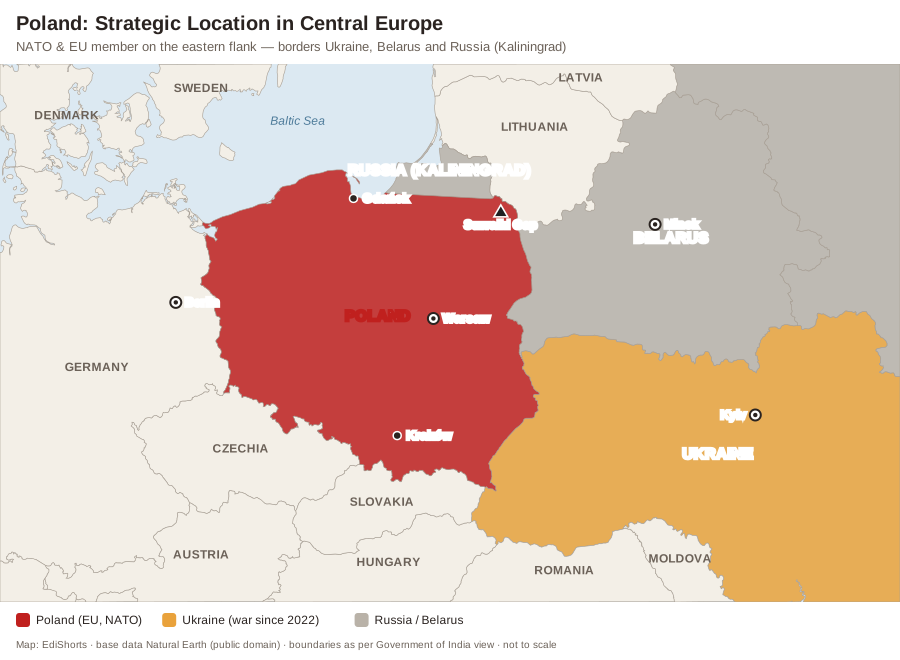
- Front-line state: Poland is the main logistics hub for Western aid to Ukraine and one of NATO’s biggest defence spenders (above 4% of GDP) — a voice India needs to understand on the war.
- EU decision-making: as a large member state, Poland’s vote counts in EU trade, carbon-border (CBAM) and technology-regulation debates that affect Indian exporters.
Challenges in the Relationship
- Trust deficit on defence partners: India’s enduring defence ties with Russia sit uneasily with Warsaw, which openly criticised India’s military exercises with Russia earlier in 2026; conversely, Poland trained Pakistan’s early Air Force and signed a defence-cooperation agreement with Pakistan in 2018.
- Low base: US$ 6 billion is small compared with India’s trade with Germany or France; MoUs have not always turned into joint ventures — Tusk himself flagged the challenge of “translating” agreements into business.
- Different threat perceptions: for Poland, Russia is the existential threat; for India, Russia is a time-tested partner and China the main strategic challenge.
- Regulatory frictions: EU-level measures (CBAM, deforestation regulation, data rules) shape what Poland can offer bilaterally.
Way Forward
- Conclude the classified-information agreement so the Defence Industry Dialogue can produce co-development and co-production under Make in India.
- Use the India–EU FTA to anchor Polish investment in Indian manufacturing (electronics, food processing, clean energy) and Indian IT/services expansion in Poland.
- Keep a “compartmentalised” relationship — engage on Ukraine through humanitarian issues (grain corridors, seafarers’ safety) without letting the Russia question cap the partnership.
- Build on soft power — the World War II refugee story is a unique asset for people-to-people ties and tourism.
Static Background — India–Poland Relations and Central Europe
- Diplomatic ties: established in 1954; India opened its embassy in Warsaw in 1957. Relations were close during the Cold War, when Poland was a Warsaw Pact state.
- The “Good Maharaja” story: during World War II, Jam Sahib Digvijaysinhji of Nawanagar sheltered about 1,000 Polish orphans at Balachadi near Jamnagar (from 1942); a larger camp at Valivade near Kolhapur housed about 5,000 Polish refugees. Warsaw has a “Good Maharaja Square” (Skwer Dobrego Maharadży) and a memorial to the Jam Sahib, which PM Modi visited in 2024; a memorial also stands at Valivade, Kolhapur.
- Modi’s visit, August 2024: first Indian PM visit to Poland in 45 years (after Morarji Desai, 1979). Ties were raised to a Strategic Partnership and a five-year Action Plan (2024–2028) was adopted; a Social Security Agreement was also concluded.
- Poland in European institutions:
- NATO member since 1999; EU member since 2004 (the “big bang” enlargement); Schengen since 2007.
- Not in the eurozone — currency is the złoty.
- Visegrád Group (V4, 1991): Poland, Czechia, Slovakia, Hungary.
- Weimar Triangle (1991): France, Germany, Poland.
- Three Seas Initiative (2016): 13 EU states between the Baltic, Adriatic and Black Seas, launched by Poland and Croatia for North–South infrastructure.
- History in one line each: the 1980 Solidarity (Solidarność) trade union at the Gdańsk shipyard, led by Lech Wałęsa, began the fall of communism in Eastern Europe; Poland was the first Soviet-bloc state to hold semi-free elections (1989).
- Geography: capital Warsaw on the Vistula, Poland’s longest river (drains into the Baltic at Gdańsk); southern border along the Carpathian and Sudeten mountains; Oder–Neisse line forms the border with Germany.
- Suwałki Gap: a roughly 65–100 km strip of Polish–Lithuanian border between Belarus and Russia’s Kaliningrad exclave — NATO’s most sensitive chokepoint, because it is the only land link to the Baltic states.
- India–EU FTA timeline: Broad-based Trade and Investment Agreement (BTIA) talks began in 2007 and stalled in 2013; relaunched in June 2022; negotiations concluded at the India–EU Summit on 27 January 2026; formal signing expected in Brussels in December 2026, with entry into force around February–March 2027. Separate tracks: an Investment Protection Agreement and an agreement on Geographical Indications.
| Grouping | Year | Members | Note |
|---|---|---|---|
| Visegrád Group (V4) | 1991 | Poland, Czechia, Slovakia, Hungary | Named after a 1335 royal meeting at Visegrád, Hungary |
| Weimar Triangle | 1991 | France, Germany, Poland | Political dialogue forum |
| Three Seas Initiative | 2016 | 13 EU states (Baltic–Adriatic–Black Sea) | Infrastructure, energy, digital links |
| Bucharest Nine (B9) | 2015 | 9 NATO states on the eastern flank | Poland and Romania initiated it |
Exam Angle — Prelims & Mains
- UPSC PYQ Link (Mains 2023, GS Paper 2): “The expansion and strengthening of NATO and a stronger US-Europe strategic partnership works well for India.” What is your opinion about this statement? Give reasons and examples to support your answer.
- UPSC PYQ Link (Prelims 2017): “Broad-based Trade and Investment Agreement (BTIA)” is sometimes seen in the news in the context of negotiations held between India and — the European Union (answer (a)).
- Practice Mains Question (GS Paper 2, 15 marks, 250 words): Central and Eastern Europe has emerged as a new frontier in India’s engagement with the European Union. Discuss the opportunities and constraints in India–Poland relations in the light of the war in Ukraine.
- Prelims Angle: European groupings and their members, the Suwałki Gap and Kaliningrad, and the India–EU FTA timeline are the likely picks.
- Practice Prelims MCQ 1: Consider the following countries:1. Poland2. Hungary3. Austria4. CzechiaHow many of the above are members of the Visegrád Group?(A) Only one(B) Only two(C) Only three(D) All four
Show answer
Answer: (C) Only three — Poland, Hungary and Czechia are members along with Slovakia. Austria is not a member of the Visegrád Group. - Practice Prelims MCQ 2: With reference to the “Suwałki Gap”, which one of the following statements is correct?(A) It is a sea passage linking the Baltic Sea and the North Sea.(B) It is a river valley forming the border between Poland and Germany.(C) It is a mountain pass in the Carpathians linking Poland and Ukraine.(D) It is a land corridor between Belarus and Russia’s Kaliningrad exclave along the Poland–Lithuania border.
Show answer
Answer: (D) — The Suwałki Gap is the strip of the Polish–Lithuanian border lying between Belarus and Kaliningrad; it is NATO’s only land link to the Baltic states. The Poland–Germany border is the Oder–Neisse line, and the Baltic–North Sea link is through the Danish straits. - Practice Prelims MCQ 3: Consider the following statements:1. Poland joined the European Union in 2004 and uses the euro as its currency.2. India and Poland elevated their ties to a Strategic Partnership during the Indian Prime Minister’s visit to Warsaw in 2024.3. During World War II, Polish refugee children were sheltered at Balachadi near Jamnagar.Which of the statements given above is/are correct?(A) 1 and 2 only(B) 2 and 3 only(C) 3 only(D) 1, 2 and 3
Show answer
Answer: (B) 2 and 3 only — Statement 1 is INCORRECT — Poland joined the EU in 2004 but is not in the eurozone; its currency is the złoty. Statement 2 is CORRECT — ties became a Strategic Partnership in August 2024. Statement 3 is CORRECT — the Jam Sahib of Nawanagar sheltered about 1,000 Polish children at Balachadi.
- Practice Prelims MCQ 1: Consider the following countries: