Why in News: India hosted the first-ever meeting of BIMSTEC Home Ministers in New Delhi on 13 October 2026, chaired by Union Home Minister Amit Shah. Member States adopted the Delhi Declaration, pledging joint action against terrorism, transnational organised crime, illicit drug trafficking, money laundering and cybercrime, and agreeing to hold such meetings regularly. The mechanism traces back to the 4th BIMSTEC Summit (Kathmandu, 2018) and was welcomed at the 6th Summit in Bangkok (2025).
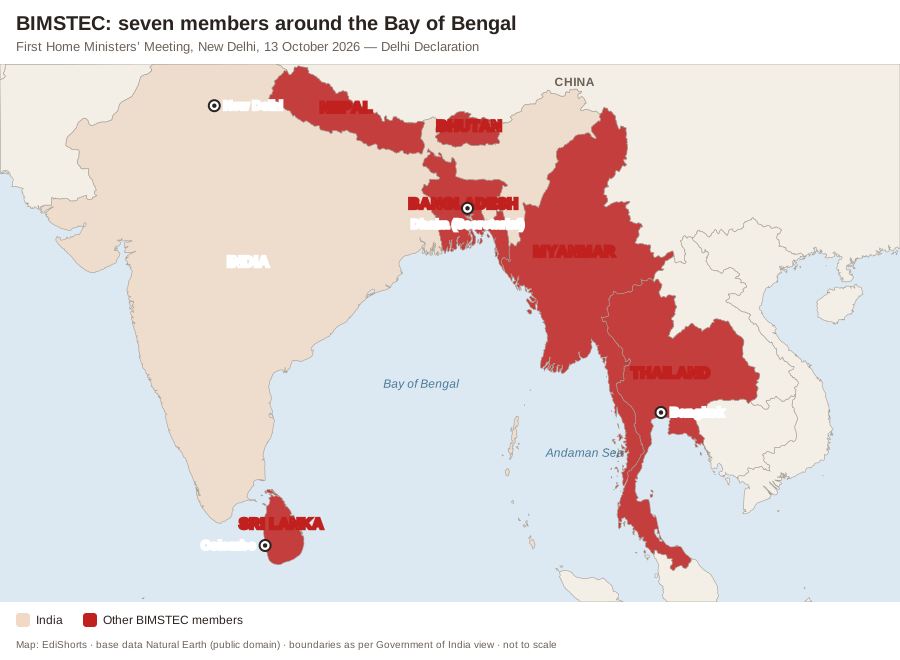
Key Outcomes of the Delhi Declaration
- Implement existing BIMSTEC instruments — especially the Convention on Cooperation in Combating International Terrorism, Transnational Organised Crime and Illicit Drug Trafficking (signed 2009).
- Finalise new legal instruments, including mutual legal assistance in criminal matters and extradition-related cooperation.
- Regional initiatives on human trafficking, drug control, money laundering and terror financing, illicit financial flows and disaster management.
- Expand training (Indian police and forensic institutions) and real-time information sharing; cooperation against cyber fraud compounds operating from the region.
Why It Matters for India
- Cyber-scam centres in Myanmar and along the Thai border have trapped Indian workers; coordinated rescue and prosecution need regional cooperation.
- Drug trafficking from the Golden Triangle (Myanmar–Laos–Thailand) feeds India’s North-East.
- Insurgent groups in the North-East have used camps across borders.
- With SAARC stalled since 2016, BIMSTEC is India’s main regional forum — linking “Neighbourhood First” and “Act East”.
Challenges
- Political turbulence in Myanmar and Bangladesh; differing threat perceptions.
- BIMSTEC’s slow pace: the FTA framework (2004) is still not concluded; a small Secretariat with limited funds.
- Overlap with bilateral mechanisms and China’s growing presence in the Bay of Bengal.
Static Background — BIMSTEC
- Origin: Bangkok Declaration, June 1997, as BIST-EC (Bangladesh, India, Sri Lanka, Thailand); Myanmar joined in December 1997; Nepal and Bhutan in 2004 — renamed the Bay of Bengal Initiative for Multi-Sectoral Technical and Economic Cooperation.
- Members: 5 South Asian (Bangladesh, Bhutan, India, Nepal, Sri Lanka) + 2 South-East Asian (Myanmar, Thailand).
- Secretariat: Dhaka (since 2014).
- Charter: adopted at the 5th Summit (Colombo, 2022) — BIMSTEC gained a legal personality; the charter came into force in 2024. Sectors reduced to seven, with India leading Security (counter-terrorism, transnational crime, disaster management, energy).
- 6th Summit (Bangkok, April 2025): Bangkok Vision 2030 and an agreement on maritime transport cooperation; chairship passed to Bangladesh.
- Covers about 22% of the world’s population; the Bay of Bengal is the largest bay in the world.
| BIMSTEC milestone | Year |
|---|---|
| Bangkok Declaration (BIST-EC) | 1997 |
| Nepal and Bhutan join | 2004 |
| Secretariat at Dhaka | 2014 |
| Charter adopted (Colombo) | 2022 |
| First Home Ministers’ Meeting (Delhi) | 2026 |
Exam Angle — Prelims & Mains
- UPSC PYQ Link (Mains 2022, GS Paper 2): Do you think that BIMSTEC is a parallel organisation like the SAARC? What are the similarities and dissimilarities between the two? How are Indian foreign policy objectives realized by forming this new organisation?
- Practice Mains Question (GS Paper 2, 15 marks, 250 words): BIMSTEC has emerged as India’s preferred platform for regional cooperation. Examine its potential for addressing non-traditional security threats in the Bay of Bengal region.
- Prelims Angle: members, Secretariat, charter and founding declaration.
- Practice Prelims MCQ 1: Consider the following countries:1. Bhutan2. Maldives3. Myanmar4. AfghanistanHow many of the above are members of BIMSTEC?(A) Only one(B) Only two(C) Only three(D) All four
Show answer
Answer: (B) Only two — Bhutan and Myanmar are members. The Maldives and Afghanistan are SAARC members but not in BIMSTEC. - Practice Prelims MCQ 2: Consider the following statements about BIMSTEC:1. It was established through the Bangkok Declaration of 1997.2. Its permanent Secretariat is located in Kathmandu.3. Its Charter was adopted at the Colombo Summit in 2022.Which of the statements given above are correct?(A) 1 and 2 only(B) 2 and 3 only(C) 1 and 3 only(D) 1, 2 and 3
Show answer
Answer: (C) 1 and 3 only — Statement 1 is CORRECT and Statement 3 is CORRECT. Statement 2 is INCORRECT — the Secretariat is in Dhaka; Kathmandu hosts the SAARC Secretariat.
- Practice Prelims MCQ 1: Consider the following countries: