Why in News: The defence ministries of Pakistan, Qatar, Indonesia and Türkiye — with Pakistan’s Defence Industrial Production organisation and Türkiye’s Presidency of Defence Industries — signed the “Badr” Memorandum of Understanding in Doha on 21 October 2026. It sets up a framework for joint military production, technology sharing, technical training and research. It is a defence-industrial arrangement, not a collective-defence pact.
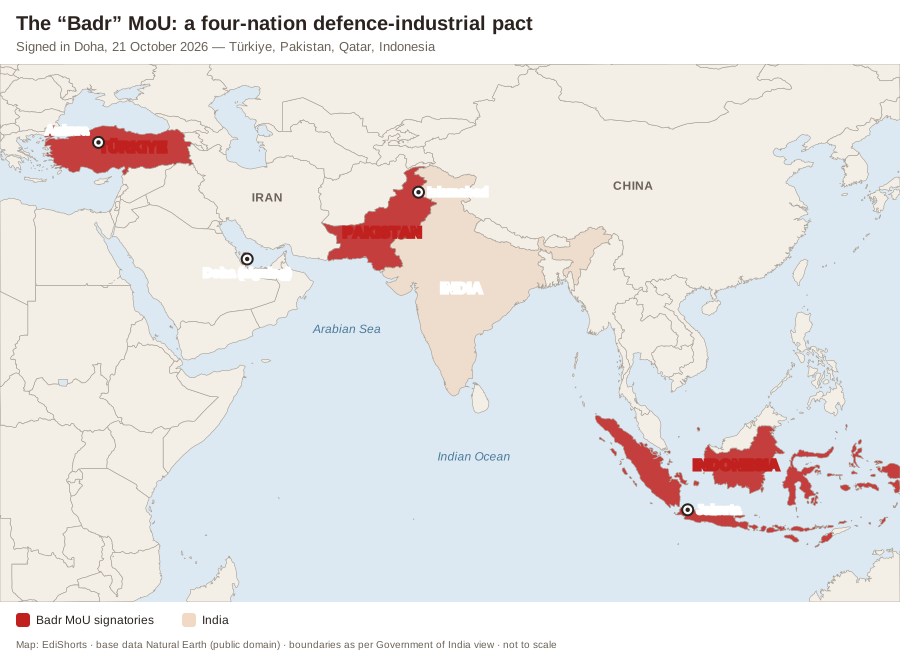
What Each Partner Brings
- Türkiye: a fast-growing defence industry — drones (Bayraktar TB2, Akıncı), MILGEM corvettes, the KAAN fighter programme.
- Pakistan: manufacturing base (Heavy Industries Taxila, Pakistan Aeronautical Complex) and a large military market; already building Babur-class corvettes with Türkiye.
- Indonesia: a large market and shipbuilding; it has ordered Turkish KAAN jets and frigates.
- Qatar: finance and investment.
Why It Matters for India
- It deepens Türkiye–Pakistan defence ties after Türkiye’s open support to Pakistan during Operation Sindoor (May 2025) and Turkish drones’ use by Pakistan.
- It could reduce Pakistan’s heavy dependence on China for weapons while widening its access to technology and funding.
- Indonesia and Qatar are important Indian partners — Indonesia is negotiating the BrahMos missile and was Republic Day chief guest in 2025; Qatar is India’s top LNG supplier historically and a strategic partner since 2025.
- It adds to other Pakistan-centred arrangements, such as the Pakistan–Saudi Arabia Strategic Mutual Defence Agreement (September 2025).
India’s Response Options
- Deepen bilateral defence ties with Indonesia (BrahMos, shipbuilding, maritime domain awareness) and with the Gulf.
- Strengthen partnerships with Greece, Cyprus and Armenia as counterweights to Türkiye in its neighbourhood (Armenia is a major buyer of Indian artillery and Pinaka rockets).
- Scale up India’s own defence exports — they reached record levels in 2025–26 — and the domestic industrial base.
Static Background — Defence Groupings and India’s Partners
- Collective-defence pacts vs industrial MoUs: NATO’s Article 5 obliges members to treat an attack on one as an attack on all; an industrial MoU carries no such obligation.
- OIC: Organisation of Islamic Cooperation (1969, Jeddah) — 57 members; all four Badr signatories are members.
- India–Indonesia: Comprehensive Strategic Partnership (2018); coordinated patrols (CORPAT) and the Samudra Shakti naval exercise; the Garuda Shakti special-forces exercise.
- India–Qatar: Strategic Partnership (February 2025); target to double trade to US$ 28 billion by 2030.
- Türkiye: NATO member since 1952; controls the Bosphorus and Dardanelles straits (Montreux Convention, 1936).
| Badr partner | India’s key link |
|---|---|
| Indonesia | Comprehensive Strategic Partnership; BrahMos talks |
| Qatar | Strategic Partnership (2025); LNG |
| Türkiye | Strained ties; NATO member |
| Pakistan | Adversary; China–Pakistan nexus |
Exam Angle — Prelims & Mains
- UPSC PYQ Link: Mains GS-2 has asked about India’s West Asia and neighbourhood policy; no question directly on this MoU.
- Practice Mains Question (GS Paper 2, 10 marks, 150 words): Defence-industrial alignments among middle powers are reshaping security in India’s extended neighbourhood. Examine the implications of the Badr MoU for India.
- Prelims Angle: Montreux Convention, OIC and India’s exercises with Indonesia.
- Practice Prelims MCQ 1: Consider the following statements:1. The Badr MoU commits its signatories to treat an attack on one as an attack on all.2. All four signatories of the Badr MoU are members of the Organisation of Islamic Cooperation.3. Türkiye is a member of NATO.Which of the statements given above are correct?(A) 1 and 2 only(B) 2 and 3 only(C) 1 and 3 only(D) 1, 2 and 3
Show answer
Answer: (B) 2 and 3 only — Statement 1 is INCORRECT — it is a defence-industrial framework without a collective-defence clause. Statement 2 is CORRECT. Statement 3 is CORRECT — Türkiye joined NATO in 1952. - Practice Prelims MCQ 2: The Montreux Convention of 1936 regulates passage through which of the following?(A) Strait of Gibraltar(B) Turkish Straits (Bosphorus and Dardanelles)(C) Suez Canal(D) Strait of Hormuz
Show answer
Answer: (B) — The Montreux Convention gives Türkiye control over the Turkish Straits and limits warships of non-Black Sea States.
- Practice Prelims MCQ 1: Consider the following statements: