Why in News: The Nanda Devi Biosphere Decadal Monitoring Campaign 2026, by the Uttarakhand Forest Department and the Wildlife Institute of India, found that landslide-prone zones inside the strictly protected core of the Nanda Devi Biosphere Reserve have nearly doubled since 2015. Separately, a study at Kedarnath found that tourist waste and feeding are changing the foraging behaviour of Himalayan tahr, prompting plans to restrict human activity in the area.
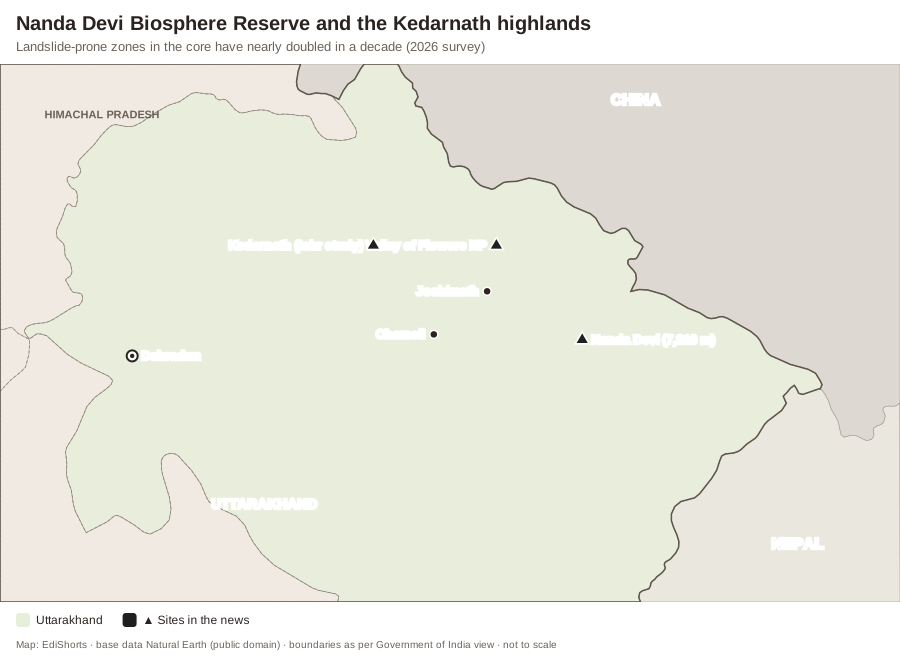
Key Findings
- Landslides: identified through field surveys, satellite imagery and drone data; the report recommends regular ecological surveys, satellite monitoring of glacial lakes and early-warning systems.
- Even a core zone with almost no human presence is destabilising — pointing to climate-driven causes: glacier retreat, permafrost thaw, extreme rainfall and freeze–thaw cycles.
- Tahr at Kedarnath: animals near the pilgrimage route feed on food waste, lose fear of people and face disease and conflict.
Why It Matters
- The Chamoli disaster of February 2021 (a rock–ice avalanche in the Rishiganga valley that destroyed hydropower projects) and the Joshimath land subsidence crisis (January 2023) both lie in this landscape.
- Pilgrim numbers to the Char Dham have risen sharply with better roads; carrying capacity studies are pending.
- The region feeds the Alaknanda and Dhauliganga — any instability cascades downstream as floods and sediment.
Way Forward
- Carrying-capacity limits and waste management on pilgrimage routes; ban on feeding wildlife.
- Integrated landslide and GLOF early warning (NDMA guidelines, ISRO’s Landslide Atlas).
- Strict environmental scrutiny of roads and hydropower in paraglacial zones; follow the Supreme Court’s concerns on Himalayan carrying capacity.
Static Background — Nanda Devi and the Himalayan Tahr
- Nanda Devi Biosphere Reserve: notified in 1988; added to UNESCO’s World Network of Biosphere Reserves (Man and the Biosphere) in 2004. Its core — Nanda Devi National Park and the Valley of Flowers National Park — is a natural World Heritage Site (Nanda Devi 1988, extended to include the Valley of Flowers in 2005).
- Nanda Devi (7,816 m) is the second-highest peak in India and the highest lying entirely within India (Kangchenjunga, the highest, is on the India–Nepal border).
- Biosphere reserve zones: core (strictly protected), buffer (research and limited use), transition (human settlements and sustainable use).
- Himalayan tahr: a wild goat of steep slopes; IUCN Near Threatened; found in Uttarakhand, Himachal, Sikkim and Nepal. Not to be confused with the Nilgiri tahr (Endangered; State animal of Tamil Nadu; Tamil Nadu’s 2026 count was 1,364).
- India has 18 biosphere reserves, 13 of them on UNESCO’s World Network (the Cold Desert reserve was added in 2025).
| Feature | Nanda Devi Biosphere Reserve |
|---|---|
| Notified | 1988 |
| UNESCO MAB | 2004 |
| Core | Nanda Devi NP + Valley of Flowers NP |
| State | Uttarakhand |
Exam Angle — Prelims & Mains
- UPSC PYQ Link: Prelims has asked about biosphere reserves on UNESCO’s list and about the Valley of Flowers; Mains GS-3 on Himalayan disasters and landslides.
- Practice Mains Question (GS Paper 3, 15 marks, 250 words): Even the protected core of the Himalaya is becoming unstable. Discuss the climatic and human drivers of rising landslide risk in Uttarakhand and suggest a disaster-resilient development path.
- Prelims Angle: biosphere reserve zones, World Heritage status and tahr species.
- Practice Prelims MCQ 1: Consider the following statements:1. The core of the Nanda Devi Biosphere Reserve includes the Valley of Flowers National Park.2. Nanda Devi is the highest peak lying entirely within India.3. The Himalayan tahr is the State animal of Tamil Nadu.Which of the statements given above are correct?(A) 1 and 2 only(B) 2 and 3 only(C) 1 and 3 only(D) 1, 2 and 3
Show answer
Answer: (A) 1 and 2 only — Statement 1 is CORRECT and Statement 2 is CORRECT. Statement 3 is INCORRECT — Tamil Nadu’s State animal is the Nilgiri tahr, a different species. - Practice Prelims MCQ 2: In a biosphere reserve, human settlements and sustainable resource use are permitted mainly in the:(A) Core zone(B) Buffer zone(C) Transition zone(D) Core and buffer zones equally
Show answer
Answer: (C) — The transition zone is the outermost area where communities live and practise sustainable use; the core is strictly protected.
- Practice Prelims MCQ 1: Consider the following statements: