Why in News: US Secretary of State Marco Rubio, visiting Mumbai and Jamnagar in October 2026, called India a “refining superpower” able to process heavy crude and urged Reliance Industries to produce and refine more Venezuelan oil. He also said Venezuela’s interim leader would visit India for oil talks. Since the US captured President Nicolás Maduro in January 2026, Washington has effectively steered Venezuela’s oil sector. Rubio arrived days after President Trump waived potential sanctions on major buyers of Russian oil, including India.
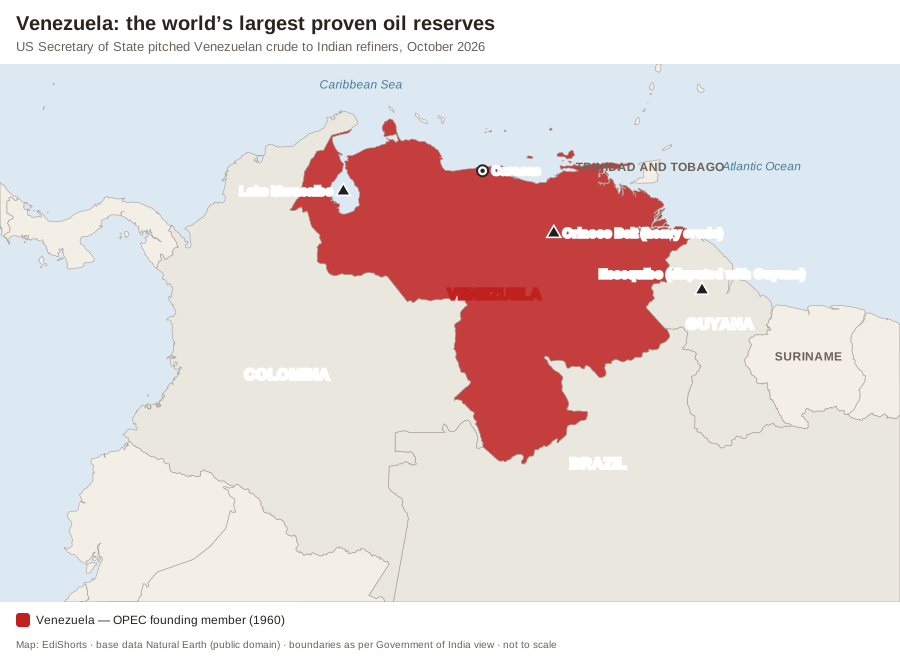
Why Venezuela Matters
- World’s largest proven oil reserves — about 300 billion barrels, most of it extra-heavy crude in the Orinoco Belt.
- Output collapsed from about 3 million barrels a day in the late 1990s to under 1 million because of mismanagement, under-investment and US sanctions.
- Heavy, sour crude needs complex refineries with coking units — which India has (Jamnagar is the world’s largest single-site refinery complex).
India’s Angle
- Diversification: India imports about 85–88% of its crude; Russia became its top supplier after 2022, followed by Iraq, Saudi Arabia and the UAE. Venezuelan crude gives another source and discounts for heavy grades.
- Past exposure: India was a big buyer of Venezuelan oil before 2019 sanctions; ONGC Videsh has stakes in the San Cristóbal and Carabobo-1 projects with unpaid dividends.
- Strategic autonomy: buying from Venezuela at Washington’s urging must be balanced with India’s Russia ties, trade negotiations with the US and its non-interventionist stance.
Concerns
- Legitimacy and stability: Venezuela’s political transition is contested; investment and offtake carry legal risk.
- Sanctions uncertainty: licences can be reversed; payment channels are difficult.
- Climate: heavy crude is more carbon-intensive to extract and refine.
Static Background — Oil Geography and OPEC
- OPEC: founded in Baghdad in September 1960 by Iran, Iraq, Kuwait, Saudi Arabia and Venezuela; headquarters Vienna; OPEC+ (since 2016) includes Russia and others.
- Largest proven reserves: Venezuela, Saudi Arabia, Iran, Canada (oil sands), Iraq.
- Venezuela: capital Caracas; Lake Maracaibo — one of the oldest oil regions; the Orinoco river; Angel Falls — the world’s highest uninterrupted waterfall; dispute with Guyana over the Essequibo region (ICJ case).
- India’s Strategic Petroleum Reserves: Visakhapatnam, Mangaluru and Padur — about 5.33 million tonnes, run by ISPRL.
- Crude benchmarks: Brent (North Sea), WTI (US), Dubai/Oman (Gulf); India uses the Indian Basket.
| Rank | Proven oil reserves |
|---|---|
| 1 | Venezuela |
| 2 | Saudi Arabia |
| 3 | Iran |
| 4 | Canada |
| 5 | Iraq |
Exam Angle — Prelims & Mains
- UPSC PYQ Link: Prelims has asked about OPEC and oil-producing regions; Mains GS-3 on India’s energy security and Strategic Petroleum Reserves.
- Practice Mains Question (GS Paper 2, 10 marks, 150 words): Energy security has become a tool of geopolitics. Examine India’s options in diversifying crude imports in the light of the US pitch for Venezuelan oil.
- Prelims Angle: OPEC founders, reserve rankings and Venezuelan geography.
- Practice Prelims MCQ 1: Which of the following countries were founding members of OPEC?1. Venezuela2. Nigeria3. Kuwait4. QatarSelect the correct answer using the code given below:(A) 1 and 3 only(B) 2 and 4 only(C) 1, 2 and 3 only(D) 1, 3 and 4 only
Show answer
Answer: (A) 1 and 3 only — Statement 1 is CORRECT and Statement 3 is CORRECT — the founders were Iran, Iraq, Kuwait, Saudi Arabia and Venezuela (Baghdad, 1960). Statement 2 is INCORRECT — Nigeria joined in 1971. Statement 4 is INCORRECT — Qatar joined in 1961 and left in 2019. - Practice Prelims MCQ 2: India’s Strategic Petroleum Reserves are located at:(A) Visakhapatnam, Mangaluru and Padur(B) Jamnagar, Kochi and Paradip(C) Haldia, Chennai and Kandla(D) Mumbai, Vadinar and Bina
Show answer
Answer: (A) — The Phase-I caverns are at Visakhapatnam (Andhra Pradesh), Mangaluru and Padur (Karnataka); Chandikhol (Odisha) and Padur-II are planned in Phase II.
- Practice Prelims MCQ 1: Which of the following countries were founding members of OPEC?